Daily Lives of High School Boys
男子高校生の日常 (Danshi Koukousei no Nichijou)
- Comedy
- Gag Humor
- School
- Episodes
- 12
- Duration
- 24 min per ep
- Aired
- Jan 10, 2012 to Mar 27, 2012
- Status
- Finished Airing
Synopsis
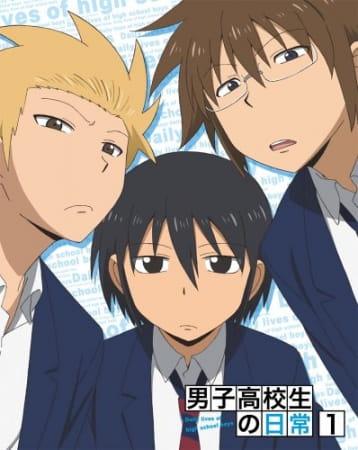
Sanada North High is an all-boys school where three friends drift through their days together: Hidenori, whose imagination runs at full speed, Yoshitake, earnest and easily fired up, and Tadakuni, the levelheaded voice of reason. In their heads, every moment can turn into giant robots, sweeping romance, or high-stakes drama—though reality usually keeps things far more ordinary.
Even so, the mundane never stays quiet for long. From overcomplicated role-playing scenarios to chance run-ins that feel momentous for reasons no one can quite explain, their attempts to kill time spiral into a steady stream of offbeat, sharply observed school-life comedy.
Otaku Consensus
Daily Lives of High School Boys earns its strong fan standing by treating throwaway adolescent nonsense with surgical comic timing: Shinji Takamatsu’s direction, scripting, and sound direction keep the sketch pacing sharp, while the voice performances sell deadpan embarrassment as hard as full-volume melodrama. Critics and viewers consistently single out its realistic social humor, slapstick consequences, and watch-with-friends rewatchability; the main caveat is that its deliberately episodic, skit-first structure can feel uneven for viewers who want escalation or an overarching story.
Why You Should Watch
Watch Daily Lives of High School Boys if you want the manic escalation of Nichijou without the same level of surreal fantasy, or the comic timing of school-life gag anime stripped down to awkward pauses, overcommitted role-play, and teenage bravado collapsing in public. It is especially rewarding for viewers who like sketch comedy: each episode is built from compact setups rather than a plot machine, so the pleasure is in timing, misdirection, and how quickly a normal interaction becomes socially catastrophic. The all-boys-school angle also gives it a different flavor from the usual cute-club-room formula, with Sunrise leaning into expressive restraint, sudden slapstick impact, and genre-parody overreaction. If you want comedy about social norms, male friendship, and adolescent performance without romance-drama padding, this is a precision hit.
Key Characters
- HHidenori
Hidenori is the show’s most dependable launchpad for theatrical nonsense, turning idle time into mock-epic scenarios that expose how seriously teenagers can take their own imagination.
- YYoshitake
Yoshitake works because his enthusiasm is never half-measured; fans tend to remember him as the friend who commits to a bit before checking whether it makes sense.
- TTadakuni
Tadakuni’s appeal comes from being the nominally sensible anchor in a cast where even common sense can become part of the joke.
What Makes It Stand Out
- 1
The series uses a sketch-anthology structure across 12 episodes rather than conventional school-comedy plotting, matching AniList’s very high Episodic tag and making individual skits the core unit of humor.
- 2
Shinji Takamatsu is credited as director, scriptwriter, and sound director, an unusually concentrated role set that helps explain the show’s tight control of pauses, punchlines, and abrupt tonal shifts.
- 3
Sunrise’s production favors readable staging and elastic reaction work over spectacle, letting ordinary school and urban spaces become platforms for slapstick, satire, and meta genre play.
- 4
The comedy is not weightless cartoon violence: THEM Anime Reviews specifically notes that characters often take curiously realistic damage from the slapstick, which gives the physical gags a harsher, funnier aftertaste.
- 5
Its appeal is broader than a simple boys-being-dumb format; review summaries point to jokes about social expectations and societal norms, while AniList tags such as Satire, Meta, Primarily Male Cast, and Cute Boys Doing Cute Things capture its unusual genre position.
Fun Facts & Trivia
- Fun fact 1
- Daily Lives of High School Boys aired from January 10 to March 27, 2012, finishing as a compact 12-episode TV comedy from Sunrise.
- Fun fact 2
- Yasunobu Yamauchi is credited as the original creator, while Yoshinori Yumoto handled both character design and chief animation director duties, tying the show’s simplified designs directly to its animation supervision.
- Fun fact 3
- The production credits list Kenichi Tajiri as art director and Shintarou Inoue for background art, key roles for a comedy that depends on mundane school and city settings staying visually legible.
- Fun fact 4
- Audio Highs provided the music, supporting a series that frequently parodies dramatic, romantic, and action-style moods inside short gag setups.
- Fun fact 5
- Its database reception is unusually durable for a pure gag comedy: MAL lists it at 8.22 from 444,026 votes with rank #414 and popularity #240, while AniList records an 80/100 score and 6,389 favourites.
Studios
- Sunrise