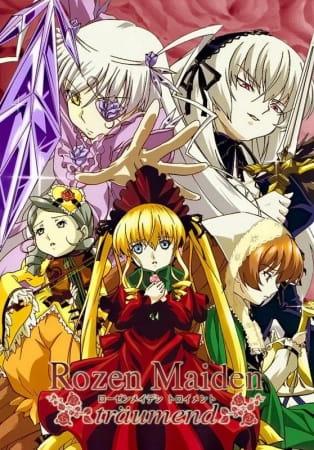
Rozen Maiden
ローゼンメイデン
- Action
- Drama
- Supernatural
- Anthropomorphic
- Urban Fantasy
- Episodes
- 12
- Duration
- 24 min per ep
- Aired
- Oct 8, 2004 to Dec 24, 2004
- Status
- Finished Airing
Synopsis
Jun Sakurada, shaken by his experiences at school, withdraws into life at home and passes the time ordering items online—only to return them before the trial period ends. When a mysterious note appears asking whether he would “wind” something, he absentmindedly marks “yes,” and a package soon arrives that upends his routine.
Inside is a wind-up doll unlike any he has seen. Once wound, she moves and speaks like a person, coolly introducing herself as Shinku, the fifth of the Rozen Maiden dolls crafted by the famed dollmaker Rozen. Bound to a supernatural contest known as the Alice Game, the sisters must fight alongside a human partner for the chance to become “Alice,” a real girl deemed worthy of meeting their creator.
As additional living dolls begin staying under Jun’s roof and a figure tied to Shinku’s past resurfaces, his quiet isolation gives way to an increasingly fraught and otherworldly daily life.
Otaku Consensus
Rozen Maiden succeeds through Kou Matsuo’s controlled tonal shifts, turning an eccentric domestic ensemble comedy into gothic drama while making Jun’s rehabilitation more emotionally consequential than the Alice Game itself. Fans consistently praise its distinctive cast and ability to move between cuteness and menace, but the 12-episode adaptation is also criticized for a slow, initially obscure narrative direction, occasional visual stasis, and substantial departures from PEACH-PIT’s manga.
Why You Should Watch
Watch Rozen Maiden if you want gothic urban fantasy driven by personality clashes and domestic intimacy rather than nonstop magical combat. Its real pleasure is the friction between aristocratic doll etiquette, childish disorder, and Jun’s deeply unglamorous struggle to rejoin life; the supernatural contest supplies pressure, but the household becomes the emotional engine. It scratches some of the same fairy-tale melancholy as Princess Tutu while offering the quarrelsome found-family appeal of Fruits Basket, only with sharper black comedy and an ornate Victorian-doll aesthetic. Miyuki Sawashiro’s coolly imperious Shinku and Rie Tanaka’s threatening Suigintou give the conflict unusual vocal authority. The early episodes take time to establish their direction, but viewers receptive to rehabilitation stories, ensemble banter, and darkness beneath cute character designs will find that patience rewarded.
Key Characters
- JJun Sakurada(VA: Asami Sanada)
Jun is compelling because his abrasive defensiveness is treated as part of a difficult rehabilitation process, not merely as a comic hikikomori trait.
- SShinku(VA: Miyuki Sawashiro)
Shinku’s ojou-sama authority, dry composure, and flashes of vulnerability make her the series’ defining balance of elegance and emotional severity.
- SSuigintou(VA: Rie Tanaka)
Suigintou supplies the story’s darkest dramatic charge, with Rie Tanaka giving her hostility a wounded intensity that exceeds a conventional rival role.
- HHinaichigo(VA: Sakura Nogawa)
Hinaichigo turns childlike neediness into both comic disruption and a test of whether this strange household can function as a genuine family.
What Makes It Stand Out
- 1
Director Kou Matsuo and series composer Jukki Hanada structure the 12 episodes around domestic coexistence as much as the supernatural battle royale, making found-family friction central rather than incidental.
- 2
Studio Nomad uses ornate doll designs and expressive faces to sell the cast’s personalities, although contemporary criticism noted that the animation could become static and was not consistently energetic.
- 3
The series pairs a primarily female ensemble with Jun’s hikikomori perspective, allowing the same household scenes to operate as comedy, character conflict, and gradual rehabilitation.
- 4
Its tonal design deliberately juxtaposes ojou-sama manners and cute family-life comedy with darker urban-fantasy imagery; enthusiastic reviews repeatedly singled out how convincingly it becomes serious after being playful.
- 5
Unlike a straightforward tournament narrative, the Alice Game remains partially obscured during the early episodes, a structural choice that builds atmosphere but also produced the most frequent pacing complaint in user reviews.
Fun Facts & Trivia
- Fun fact 1
- Rozen Maiden began as a PEACH-PIT manga in Monthly Comics Birz in September 2002; PEACH-PIT is also associated with DearS and Zombie-Loan.
- Fun fact 2
- The 2004 adaptation was produced by Nomad, with Kumi Ishii handling character design and Chikako Shibata serving as art director.
- Fun fact 3
- Its audiovisual pipeline included Madoka Katsunuma on color design, Katsuyoshi Kishi as director of photography, Mutsumi Takemiya as editor, and Youta Tsuruoka as sound director.
- Fun fact 4
- The anime later became a multi-era franchise: retrospective reviews of Rozen Maiden’s 2013 incarnation describe it as a continuity-shifting production involving time skips and multiple universes rather than a simple continuation of the 2004 series.
- Fun fact 5
- The franchise retained a dedicated following beyond its original broadcast, and at least one fan review traces its discovery to the widely circulated “DESU” meme associated with Rozen Maiden’s online presence.
Studios
- Nomad



![Fate/stay night [Unlimited Blade Works]](/_next/image?url=https%3A%2F%2Fd111jwrw4u3bt.cloudfront.net%2Fanime-posters%2Fposter-22297.webp&w=1920&q=75)