Mitsudomoe
みつどもえ
- Comedy
- Gag Humor
- School
- Episodes
- 13
- Duration
- 24 min per ep
- Aired
- Jul 3, 2010 to Sep 26, 2010
- Status
- Finished Airing
Synopsis
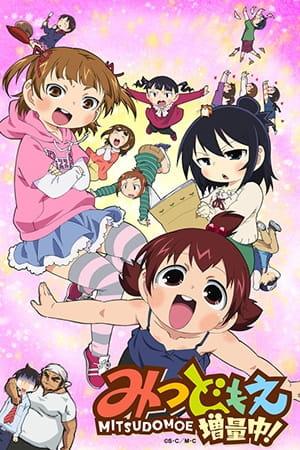
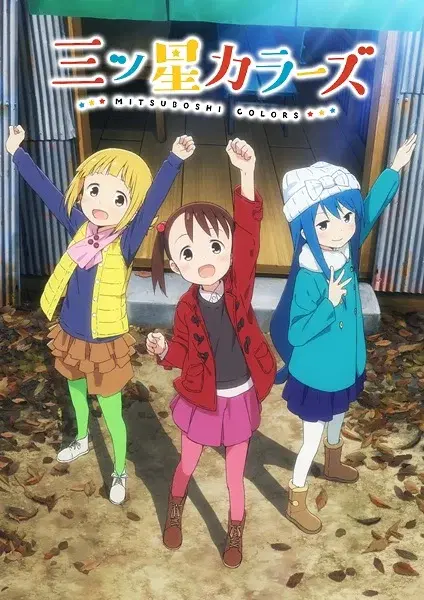
Satoshi Yabe’s first assignment as a new elementary school teacher lands him in charge of class 6-3—an unruly room packed with oddballs and nonstop commotion. The biggest handful by far is the Marui triplets: Mitsuba, a sharp-tongued girl who acts far older than her years; Futaba, unbelievably strong and unapologetically inappropriate; and Hitoha, a quiet, unsettling presence who spends her time buried in erotic books.
Once the sisters set their sights on Yabe, his days become a parade of pranks, misunderstandings, and increasingly bizarre classroom incidents. Between their relentless schemes and the chaos of 6-3, ordinary school life quickly turns into anything but routine.
Otaku Consensus
Mitsudomoe earns its cult affection by letting Masahiko Oota’s direction and Takashi Aoshima’s scripting turn Norio Sakurai’s material into a rapid-fire sketch machine, with punchlines built on escalation, bad timing, and social embarrassment rather than plot momentum. Fans and web critics consistently praise its high-energy animation, abrasive character chemistry, and willingness to go much cruder than its elementary-school packaging suggests; the recurring complaint is equally consistent: the show has almost no narrative spine, and its dirty, cringe-heavy humor is a hard filter.
Why You Should Watch
Watch Mitsudomoe if you want a school comedy that behaves less like cozy cute-girls slice of life and more like a 13-episode slapstick demolition derby. It scratches the same chaos itch as Azumanga Daioh’s classroom eccentricity or Saiki K.’s barrage pacing, but with a nastier, more bodily, more misunderstanding-driven comic vocabulary. The ideal viewer is someone who enjoys dirty jokes, physical comedy, and “how did this get approved?” escalation without needing character arcs, romance progress, or sentimental lessons. Bridge’s adaptation keeps the rhythm aggressive: gags collide, reactions spike, and the cast is written to be funny through incompatibility rather than likability. If cringe comedy makes you lean forward instead of pause the episode, this is a strong pick.
Key Characters
- FFutaba Marui(VA: Satomi Akesaka)
Futaba is the triplet fans remember for turning innocent-looking school comedy into blunt-force slapstick, with her physicality often acting as the punchline before anyone else catches up.
- HHitoha Marui(VA: Haruka Tomatsu)
Hitoha’s deadpan quietness gives the series its creepiest comic contrast, making her the kind of kuudere presence whose stillness is usually more alarming than another character’s shouting.
- MMitsuba Marui(VA: Ayahi Takagaki)
Mitsuba’s bossy, sharp-tongued persona anchors much of the verbal comedy, especially when her self-importance crashes into the show’s talent for humiliation.
- SSatoshi Yabe(VA: Hiro Shimono)
Satoshi Yabe functions as the adult straight man in a room that refuses to respect straight men, giving Hiro Shimono plenty of material for panic, exhaustion, and comic defeat.
What Makes It Stand Out
- 1
The 13-episode TV season aired from July 3 to September 26, 2010, giving it a compact gag-comedy structure with little room for long-form plotting and maximum emphasis on recurring comic setups.
- 2
Studio Bridge produced the adaptation, with Takaharu Ookuma credited as both character designer and chief animation director; contemporary reviews specifically singled out the animation quality as one of the show’s strengths despite its sketch-driven format.
- 3
Director Masahiko Oota and series composer Takashi Aoshima give the anime a deliberately abrasive rhythm: scenes are built around misunderstandings escalating fast enough that embarrassment becomes the main engine of the comedy.
- 4
The sound side is unusually well-defined for a pure gag series, with Yasunori Ebina as sound director and Yasuhiro Misawa on music, supporting jokes that often depend on sudden tonal shifts and reaction timing.
- 5
Its reception profile is a useful warning label: MAL lists it at 7.51 from 46,425 votes while AniList sits at 71/100, and fan reviews skew passionate precisely because the same crude humor that creates 10/10 reactions is also the common turnoff.
Fun Facts & Trivia
- Fun fact 1
- Mitsudomoe is based on the original work of Norio Sakurai, with Takashi Aoshima credited not only for series composition but also for script, making him central to how the anime translates the manga’s gag timing.
- Fun fact 2
- Ayahi Takagaki and Haruka Tomatsu are both listed for theme song performance and also voice two of the Marui sisters, Mitsuba and Hitoha respectively.
- Fun fact 3
- AniList’s tag distribution is revealing: Primarily Child Cast sits at 97%, School at 86%, and Teacher at 68%, while Cute Girls Doing Cute Things is only 52%, reflecting how much harsher and more confrontational the comedy is than the surface category implies.
- Fun fact 4
- The show’s most repeated critical knock is not production quality but structure: multiple reviews praise the humor and animation while calling out the lack of real plot as the price of its gag-first design.
- Fun fact 5
- User reception often frames the anime through non-anime comedy references as much as anime ones, with reviewers comparing its violent timing to The Three Stooges and its classroom eccentricity to Azumanga Daioh.
Studios
- Bridge