The Take
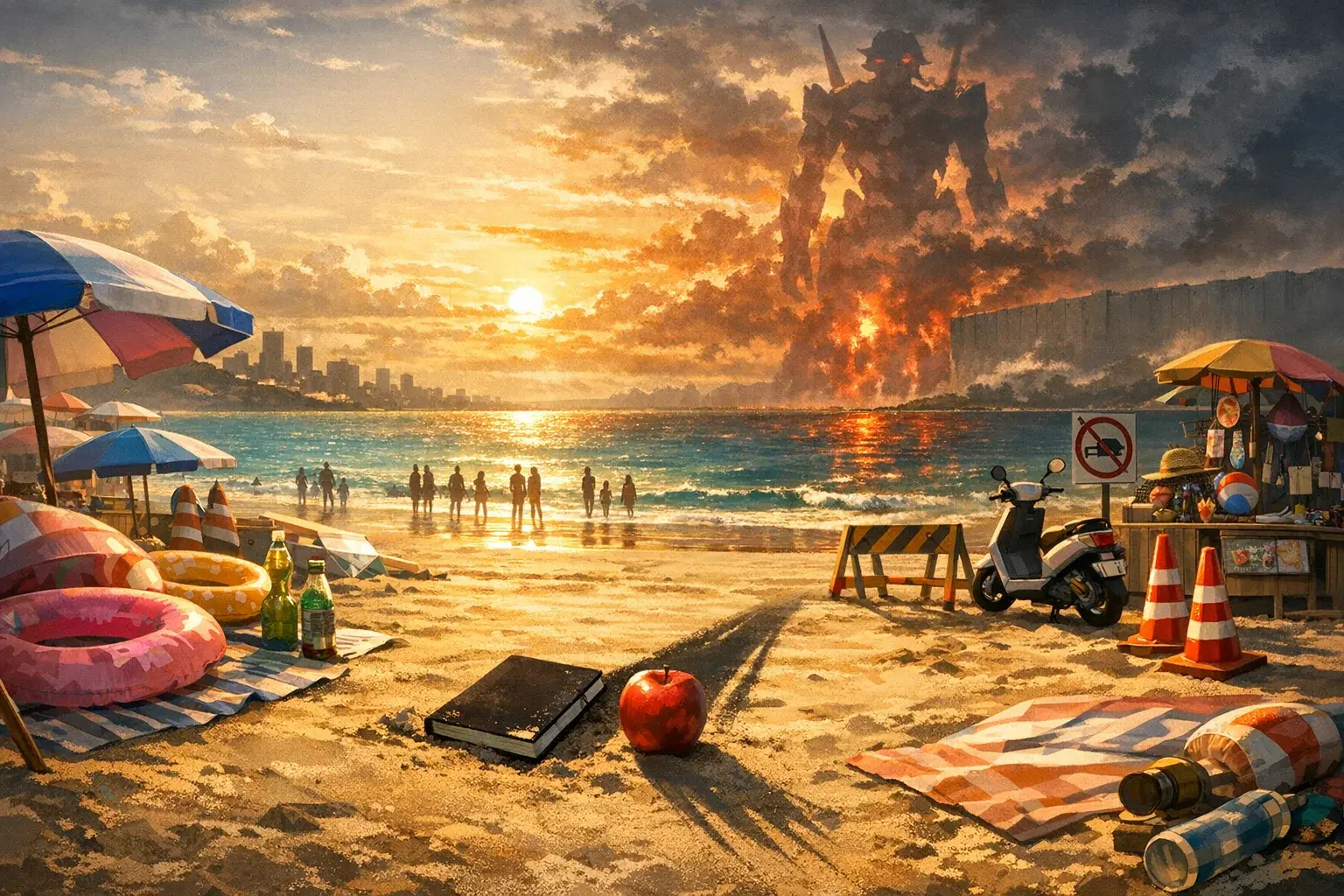
The anime beach episode survives because it is useful. Not always elegant, not always defensible, and sometimes absolutely guilty of the laziest kind of fanservice—but useful. In 2026, when fans can spot the trope from the first swimsuit preview image, it is tempting to treat every beach episode as a production committee checking a box. That misses the bigger picture. The beach episode is one of TV anime's most efficient narrative tools: it gives writers a culturally recognizable summer setting, lets exhausted casts decompress, creates low-stakes opportunities for romance and comedy, and produces visual designs that travel beautifully into posters, acrylic stands, figures, and seasonal marketing.
Otaku Insider's take: the beach episode is not the problem. Bad writing is the problem. A weak beach episode pauses the story to stare at bodies. A strong one changes how characters see each other. That is why the trope can appear in school romance, action shonen, workplace comedy, and even franchise side stories like You're Under Arrest: Diverting Traffic at the Beach. The beach is not merely a location. In anime grammar, it is a pressure valve.
The Evidence
Start with the obvious: beach episodes are tied to summer, and summer has a specific rhythm in Japanese life. Japanese school calendars generally place summer break from late July to late August, which maps neatly onto the way many school anime structure their year: entrance ceremonies, exams, festivals, summer vacation, culture festivals, winter holidays, graduation. The Japan National Tourism Organization also emphasizes July as beach season, when swimming areas open and seaside travel becomes part of the national leisure calendar. Ocean Day, first observed in 1996, further formalized the sea as a summer symbol, and government campaigns such as Japan's 100 Great Beaches underline how deeply coastal imagery sits inside modern Japanese seasonal culture.
That matters because anime is unusually good at seasonal coding. Cherry blossoms tell us a school year is beginning. Cicadas tell us it is summer. Fireworks tell us somebody is about to almost confess. Snow tells us the emotional temperature is about to drop. The beach episode belongs to that same visual language. It is instantly readable, even to international viewers who may not know the school calendar behind it.
The trope also has history. By the 1980s, TV anime had already learned that sending the cast to the shore could refresh a familiar ensemble without needing a new premise. The later existence of explicitly beach-branded specials such as You're Under Arrest: Diverting Traffic at the Beach shows how recognizable the format became: put beloved characters near the water, change the costumes, loosen the usual structure, and let the audience enjoy the cast in a different mode.
The most practical reason anime uses beach episodes, though, is pacing. Long-running or arc-driven shows need release valves. A series that only escalates eventually numbs the viewer. Even high-stakes anime like Attack on Titan, Demon Slayer: Kimetsu no Yaiba, and Jujutsu Kaisen rely on tonal contrast somewhere, even if they do not always use a traditional beach installment to get there. The beach episode is one established way to create that contrast without feeling random. It says: the characters are not in battle mode today. Watch what they do when nobody is actively trying to kill them.
That off-duty quality is crucial. Uniforms, weapons, offices, classrooms, and battlefields impose roles. The beach strips those roles away—sometimes too literally, but the storytelling point remains. Who gets competitive during volleyball? Who cannot swim? Who plays parent? Who is unexpectedly shy? Who uses vacation as another excuse to train? Those answers can deepen a cast faster than another exposition scene.
Take Toradora!, where the beach-house material is not just a sunny detour. It uses the vacation setup to intensify romantic uncertainty, force characters into shared domestic space, and let jealousy and vulnerability surface under the cover of comedy. The setting gives the characters permission to behave slightly differently from how they do at school, and that difference matters.
Or look at Assassination Classroom, a series often cited when fans argue that beach or island episodes do not have to be filler. Its resort-island material keeps the assassination premise alive while using the vacation atmosphere for strategy, bonding, and escalation. The environment changes, but the story engine does not shut off. That is the gold standard: a beach episode should alter the texture of the show, not unplug it.
My Hero Academia Season 3 offers another useful case. Its early pool-centered material functions partly as a bridge into the next major training arc, and fan documentation has long described that episode as largely anime-original. That is exactly how studios often use these installments: recap lightly, reintroduce the ensemble, give viewers a breather, and then pivot into heavier material. It is not automatically profound, but it is structurally sensible TV writing.
There is also a genre-specific reason the trope persists. Romance anime and romantic comedies need plausible excuses for intimacy. Kaguya-sama: Love is War turns social situations into tactical battlefields; a beach-style summer setup gives that kind of story a natural arena for jealousy, misread signals, and private conversations away from institutional routines. Horimiya thrives on the contrast between public image and private self; summer leisure settings are perfect for exposing that gap. Rascal Does Not Dream of Bunny Girl Senpai is built around emotional masks and adolescent vulnerability; again, a relaxed seasonal setting can make hidden feelings easier to stage.
Then there is the commercial logic, which fans should not ignore. Merriam-Webster defines fan service broadly as material designed to please fans, and in anime and manga specifically notes sexually suggestive or explicit material involving nude or scantily clad characters. The beach episode is the most socially acceptable delivery mechanism for that within a school or ensemble story: swimsuits are diegetic. No one has to invent a contrived wardrobe malfunction if the whole cast is going swimming.
Production economics make that even clearer. Industry explanations of the production committee model commonly estimate modern late-night TV anime at roughly 15–30 million yen per episode, with a 12–13 episode cour running around 200–400 million yen. Meanwhile, the Association of Japanese Animations has reported merchandising rights as a massive revenue pillar, including 700 billion yen in 2023, or about 20.9% of the broad anime market. In that context, a swimsuit design is not just a gag. It can become a scale figure, wall scroll, key visual, collaboration café standee, or limited event good. Recent swimsuit figures priced in the 17,500–22,000 yen range show how direct the path can be from seasonal episode imagery to premium collectibles.
This does not mean every beach episode is secretly dictated by the merch department. But it does mean the trope aligns unusually well with the anime business model. It generates fresh visuals without requiring a new cast. It rewards existing fans. It creates easy promotional art. And because anime is consumed globally now, the summer episode is no longer just a domestic seasonal beat—it is an exportable fan-culture event.
The Counterargument
The strongest criticism of beach episodes is simple: too many of them are boring, sexist, or both. Critics are not imagining things. When a show reduces its characters to body-type jokes, leering camera angles, and recycled embarrassment gags, the beach episode becomes the exact stereotype fans complain about. This is especially frustrating when the episode arrives during a tight season where every slot matters. In a 12-episode run, one disposable swimsuit chapter can feel like a tax on the audience's patience.
There is also a tonal problem. Not every anime benefits from sudden summer fluff. A grim thriller like Death Note or an emotionally severe work like Neon Genesis Evangelion would feel different if it casually stopped for volleyball and shaved ice. Even comedies can overplay the bit. In shows where fanservice is already part of the brand, such as KonoSuba: God's Blessing on This Wonderful World!, No Game, No Life, or Kill la Kill, audiences may disagree sharply on whether the joke is self-aware enough to justify the gaze.
But that counterargument should lead to higher standards, not a blanket rejection of the trope. The question is not whether an episode has swimsuits. The question is whether the episode has consequences. Did a relationship shift? Did a character reveal a new side? Did the tone reset make the next arc hit harder? Did the comedy come from personality rather than objectification? By that measure, Toradora! and Assassination Classroom use summer leisure far more effectively than a generic pause-button installment. The beach episode is a tool. Some shows use it like a scalpel. Others use it like a beach ball to the face.
The Conclusion
Anime uses beach episodes because they sit at the intersection of culture, character writing, and commerce. They reflect Japan's summer calendar and seaside leisure culture. They give TV stories a low-cost, instantly legible change of scenery. They let characters interact outside their normal roles. They create romance, comedy, vulnerability, and breathing room. And yes, they also generate fanservice and merchandise.
Otaku Insider's take is that the beach episode deserves neither automatic defense nor automatic dismissal. In 2026, fans are savvy enough to know when they are being pandered to. But they are also savvy enough to recognize when a familiar trope is doing real work. The best beach episodes are not vacations from the story; they are vacations that reveal the story's emotional truth.
So the next time an anime sends its cast to the shore, do not just ask whether it is filler. Ask what changes when the tide goes out. Did the episode expose something the school, battlefield, kitchen, or clubroom could not? If the answer is yes, the beach episode has earned its place. If the answer is no, well—at least the merch table will be ready.
Sources
- [1] FAN SERVICE Definition & Meaning - Merriam-Webster (merriam-webster.com)
- [2] JAPANESE EDUCATIONAL SYSTEM | JAPAN Educational Travel (education.jnto.go.jp)
- [3] "JAPAN'S 100 GREAT BEACHES" (mlit.go.jp)
- [4] List of animated media | Urusei Yatsura Wiki | Fandom (uruseiyatsura.fandom.com)
- [5] FEATURE: Actually Good Beach Episodes In Anime - Crunchyroll News (crunchyroll.com)
- [6] Miss Kobayashi's Dragon Maid Summer's Staples! (The Fanservice Episode, Frankly) - Watch on Crunchyroll (crunchyroll.com)
- [7] Episode 39 | My Hero Academia Wiki | Fandom (myheroacademia.fandom.com)
- [8] 1/7スケールフィギュア 八奈見杏菜 水着Ver. | GOOD SMILE COMPANY (info.goodsmile.com)
- [9] My Dress Up Darling Marin Kitagawa Swimsuit 1/7 Scale Figure| Aniplex Online (store.aniplexusa.com)
- [10] An Explanation of the Licensing Structure of Anime Figurines – Who is the Rightsholder? — TRAVESIA Inc. (Osaka & Tokyo) (travesia.jp)
- [11] Source (aja.gr.jp)
- [12] Haibara's Teenage New Game+ Episode 9 Story & Preview Cuts Released | Japan Anime News powered by ORICON NEWS (us.oricon-group.com)
- [13] beach episode - Wiktionary, the free dictionary (en.wiktionary.org)
- [14] 『『魔法少女にあこがれて』 マジアベーゼ 水着ver.』 | PRODUCT | KDcolle(KADOKAWAコレクション) | KADOKAWA (kdcolle.kadokawa.co.jp)
- [15] 「アニメ産業レポート2025」2025年12月上旬刊行決定|10月30日(木)より先行予約受付開始、12月下旬には刊行セミナーも開催 | 一般社団法人 日本動画協会のプレスリリース (prtimes.jp)
- [16] Japan in July | Guide | Travel Japan(Japan National Tourism Organization) (japan.travel)
- [17] Summer 2026 Anime Rankings - Week 1 (ANIME_CORNER)
- [18] Chitose Is in the Ramune Bottle Anime Cour 2 Broadcasts in October (CRUNCHYROLL)
- [19] Hono no Tokyujo: Dodge Danko Anime Shares Explosive Creditless Opening, Ending Videos (CRUNCHYROLL)
- [20] KAIJU GIRL CARAMELISE Anime Shares Big Feelings in Creditless Opening, Ending Videos (CRUNCHYROLL)
- [21] Queen Bee Shares Jaadugar: A Witch in Mongolia Anime Ending Song Music Video (CRUNCHYROLL)
- [22] Dannie May Drops Yoroi-Shinden Samurai Troopers Cour 2 Anime Opening Song Music Video (CRUNCHYROLL)
- [23] Even the Student Council Has Its Holes! Anime Reveals Hisako Kotobuki Cast (CRUNCHYROLL)
- [24] Anime Expo 2026 Wraps its 35th Edition With Attendees from Over 65 Countries and Over 1,4000 Hours of Programming (ANN)
- [25] Chitose Is in the Ramune Bottle Anime's 2nd Part Debuts in October (ANN)
- [26] Crunchyroll Reveals Cast, Staff for Same-Day English Dub of Hanaori-san Still Wants to Fight in the Next Life Anime (ANN)
- [27] Kagurabachi Anime Expo Premiere Review: Bloody and Brilliant (ANIME_CORNER)
- [28] Mebius Dust Anime Releases 2nd Main Trailer (CRUNCHYROLL)
- [29] The Elusive Samurai Season 2 Anime Reveals Ending Theme Song Performer (CRUNCHYROLL)
- [30] Imase Releases Smoking Behind the Supermarket with You Anime Ending Song Collab Music Video (CRUNCHYROLL)
- [31] Red River Anime Begins Its Journey with Creditless Opening Video (CRUNCHYROLL)
Written by Ranen with AI support — Ranen picks every story, shapes the angle, and reviews each article before it's published. Learn more in our editorial policy.