The Take
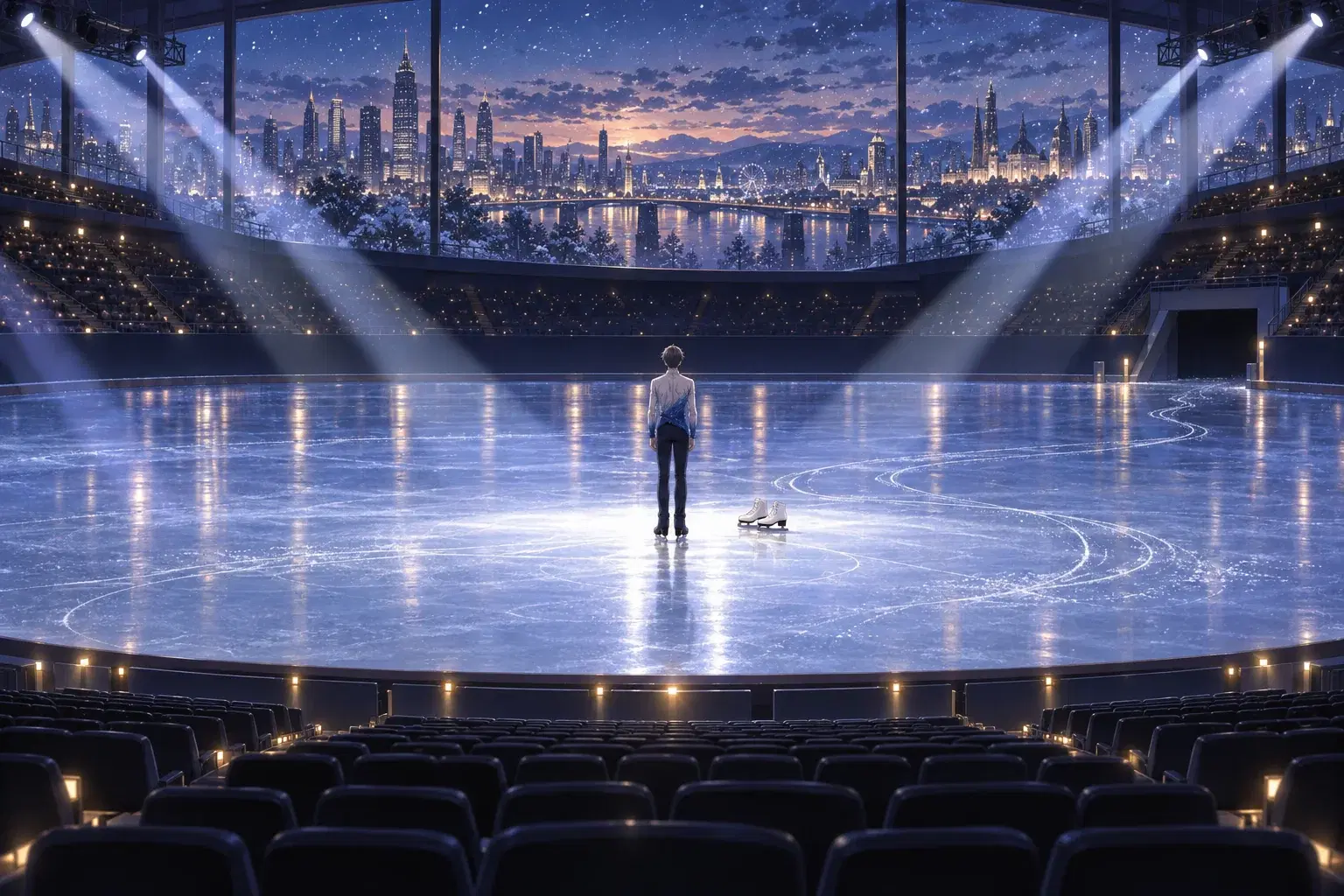
A beloved 2016 anime returning to cinemas should feel purely celebratory. Instead, today’s tenth-anniversary screening carries an unavoidable note of grief. At 7:00 p.m. local time on October 19, selected theatres in the United States and Canada will present the first five episodes as part of Crunchyroll Anime Nights. That is a welcome opportunity to experience the series with an audience—but it is not a sequel, revival, recut or replacement for the theatrical project announced in 2017 and cancelled in April 2024.
That distinction matters because the anniversary campaign proves the franchise still possesses cultural and commercial power. Tickets can be sold, collector products can be produced, exhibitions can be planned and professional skaters can be recruited for commemorative material. Yet the one thing fans spent years anticipating—a new narrative—remains absent.
Our position is straightforward: celebrating the original series is worthwhile, but nostalgia cannot settle the debt created by years of official promises and opaque delays. The screening preserves a landmark anime; it also demonstrates how readily the industry can continue monetizing an audience after abandoning the project that audience was encouraged to expect.
The Evidence
The immediate facts need to be kept precise. The Outerhaven’s report was published on October 8, while October 19 is the event date. The presentation covers episodes one through five of the 12-episode television series. A Canadian exhibitor listing identifies the participating presentation as Japanese audio with English subtitles, although locations and showtimes vary. This is catalog programming, not a new 2026 production.
What makes that catalog valuable is the extraordinary impact of the original. Created by Mitsurou Kubo and director-series composer Sayo Yamamoto, with animation production by MAPPA and skating choreography by Kenji Miyamoto, the series turned an athlete’s crisis of confidence into an unusually intimate sports drama. Its competitive structure gave the story propulsion, but its emotional center was the evolving bond between anxious Japanese skater Yuri Katsuki and Russian champion Victor Nikiforov.
That combination reached far beyond the conventional sports-anime audience. The show won Anime of the Year at the inaugural Crunchyroll Anime Awards, taking more than 44% of the category vote according to Crunchyroll’s contemporary announcement](https://www.globenewswire.com/news-release/2017/01/30/1202535/0/en/yuri-on-ice-wins-anime-of-the-year-in-crunchyroll-s-first-ever-anime-awards.html). Its attention to anxiety, professional burnout and queer intimacy distinguished it even in a 2016 landscape that included theatrical sensations such as Your Name. and A Silent Voice, as well as character-driven television anime like Mob Psycho 100 and My Hero Academia.
Its legacy is not reducible to awards. The series treated skating as performance, sport and emotional language simultaneously. Programs were not simply action sequences; they reflected how each competitor wanted to be seen. That makes the work a useful companion to Haikyu!!, which similarly finds character revelation inside athletic technique, and Your Lie in April, where performance becomes a vehicle for fear, connection and self-expression. Its crossover credibility is also visible in the anniversary campaign’s messages from prominent professional skaters, including Kaori Sakamoto, Satoko Miyahara, Kazuki Tomono and Nobunari Oda.
The broken promise began soon after that success. A completely new theatrical feature was announced on April 29, 2017. In July 2018, the production revealed a title and targeted a 2019 theatrical release. The official postponement notice, issued in September 2019, said the creators wanted to substantially expand the film’s content, but it supplied no replacement date. Promotional material focused attention on a teenage Victor, encouraging expectations of a story about his formative competitive years.
Then came silence, interrupted by occasional signs that the project still existed. Finally, on April 19, 2024, the production committee and MAPPA officially cancelled the film, citing only “various circumstances.” No detailed financial, legal, political or creative explanation was provided. Any confident claim assigning blame to one studio decision, staff dispute or outside event therefore goes beyond the available evidence.
The timeline is nevertheless damning on its own: almost seven years passed between announcement and cancellation. This was not a vague fan hope comparable to the recurring demand for more No Game, No Life. It was an officially announced feature with named staff, promotional art and an intended release window. Fans were not imagining a promise; the production made one.
Meanwhile, the tenth-anniversary machine is functioning efficiently. Tadashi Hiramatsu produced a new commemorative visual. A large winter exhibition has been announced, though its venue and dates were still unspecified when checked on October 19. A limited Blu-ray and CD box is scheduled for Japan on December 23 at ¥41,800 including tax. Its contents include all 12 episodes, music, earlier bonus material and newly filmed skating features involving Stéphane Lambiel and Shun Sato.
Otaku Insider’s take: those projects are meaningful preservation, especially for an original anime without a continuing manga source. But they also expose the asymmetry of anniversary culture. Repackaging completed work is manageable; financing new animation is risky. The audience receives access to the past because the future proved harder to deliver.
The Counterargument
There is a strong case for accepting the screening on its own terms. A film cancellation does not invalidate the television series, and refusing every anniversary activity would only deprive fans of communal experiences. Watching five episodes in a theatre can transform familiar material: musical cues become larger, skating sequences gain physical force and moments once experienced alone become shared reactions. For newcomers, the event offers a curated introduction; for longtime viewers, it is a reunion.
Nor should every successful anime be required to continue indefinitely. Some works retain their power precisely because they are concise. Cowboy Bebop and Toradora!, for example, remain discussion staples without needing constant narrative expansion. The original skating drama also reaches an emotionally satisfying stopping point, even if it leaves competitive and romantic possibilities open.
Production realities deserve consideration too. New animation demands money, available staff, workable schedules and agreement among multiple rights holders. Cancellation may have been more responsible than releasing a compromised film. Without evidence explaining the decision, accusing individual creators or animators would be unfair.
But those points do not erase the communication failure. The production did not merely decline to make more episodes; it announced a specific film, promoted it, delayed it to increase its scope and allowed expectations to persist for years. Fans can simultaneously enjoy the anniversary screening and criticize the institutions that handled the promised continuation. Celebration and disappointment are not mutually exclusive.
The Conclusion
Ten years later, this anime remains culturally significant because its emotional intelligence, skating detail and queer resonance survived the hype cycle. Today’s limited North American cinema return confirms that its audience did too. The original deserves restoration, exhibition and serious discussion rather than being remembered only as a cancelled-franchise story.
But legacy is not a substitute for accountability. The tenth-anniversary products preserve what was completed; they do not repair the trust lost when a heavily promoted film disappeared after years of delay and received only a one-paragraph explanation. If the rights holders want to honor the fandom fully, greater transparency—even a retrospective account of what prevented production—would mean more than another premium package.
Go to the screening if it is available near you. Applaud the sequences that made the series special, introduce a friend and enjoy hearing a theatre react together. Just do not let celebration rewrite the record. The anime kept its emotional promise to viewers. The industry behind it did not keep its biggest production promise—and fans are entitled to discuss both truths at once.
Sources
- [1] NYCC 2026: Crunchyroll Showcase Announcements | The Outerhaven (theouterhaven.net)
- [2] TVアニメ「ユーリ!!! on ICE」公式サイト (yurionice.com)
- [3] Yuri!!! on ICE Wins Anime of the Year in Crunchyroll's (globenewswire.com)
- [4] Anime News, Top Stories & In-Depth Anime Insights - Crunchyroll News (crunchyroll.com)
- [5] TVアニメ「ユーリ!!! on ICE」10周年記念サイト (yurionice.com)
- [6] TVアニメ「ユーリ!!! on ICE」10周年記念サイト (yurionice.com)
- [7] A monthly celebration of everything anime from Crunchyroll's library at Landmark Cinemas (landmarkcinemas.com)
- [8] "Yuri!!! On Ice" Original Anime Movie Announced - Crunchyroll News (crunchyroll.com)
- [9] TVアニメ「ユーリ!!! on ICE」公式サイト (yurionice.com)
- [10] TVアニメ「ユーリ!!! on ICE」公式サイト (yurionice.com)
- [11] TVアニメ「ユーリ!!! on ICE」公式サイト (yurionice.com)
- [12] YURI!!! on ICE the movie : ICE ADOLESCENCE Official Site (yurionice-movie.com)
- [13] TVアニメ「ユーリ!!! on ICE」10周年記念サイト (yurionice.com)
- [14] TVアニメ「ユーリ!!! on ICE」10周年記念サイト (yurionice.com)
- [15] Watch Yuri!!! on ICE - Crunchyroll (crunchyroll.com)
- [16] Full article: Media, the ambiguous, and audience: the reception of queerness, culture, and fantasy in ‘Yuri!!! on ICE’ within Japanese fandom (tandfonline.com)
- [17] TVアニメ「ユーリ!!! on ICE」10周年記念サイト (yurionice.com)
- [18] Magical DoReMi, Star Detective Precure! Anime Get Crossover Episode on October 25 (ANN)
- [19] Muv-Luv Presents 2026 to Stream on October 22 (ANN)
- [20] Animation Nation Forum Returns to Manchester this November (ANN)
- [21] Star Detective Precure! Anime Episode 39 to Feature Ojamajo Doremi Crossover (CRUNCHYROLL)
- [22] Yusei Yagi Drops Uncle's Obsession with Cute Things Anime Opening Song Music Video (CRUNCHYROLL)
- [23] A Returner's Magic Should Be Special Season 2 Anime Shares Opening, Ending Song Music Videos (CRUNCHYROLL)
- [24] Yorushika Releases The Apothecary Diaries Season 3 Anime Opening Song Music Video (CRUNCHYROLL)
- [25] Cregger's Resident Evil Opens at #2 in Japan, 5th Girls und Panzer das Finale Film Opens at #5 (ANN)
- [26] 10 Anime Characters We’d Ask to Help Make Our Halloween Costumes (CRUNCHYROLL)
- [27] Japanese Animation TV Ranking, September 28-October 4 (ANN)
- [28] Are You a Landmine, Chihara-san? Anime Premieres on January 7 (CRUNCHYROLL)
- [29] Bless Anime Introduces Akiharu Nakano in New Character Trailer (CRUNCHYROLL)
- [30] The Seven Knights of the Marronnier Kingdom Anime Adds Shoya Ishige as Johann (CRUNCHYROLL)
- [31] Shangri-La Frontier Season 3 Anime Chooses Its Fighters in 1st Exhibition Match Visual (CRUNCHYROLL)
- [32] Where Romantacy Balls and Anime Club Events Merge: A New Elegent Experience Arrives for Anime Fans (ANN)
Written by Ranen with AI support — Ranen picks every story, shapes the angle, and reviews each article before it's published. Learn more in our editorial policy.