The Take
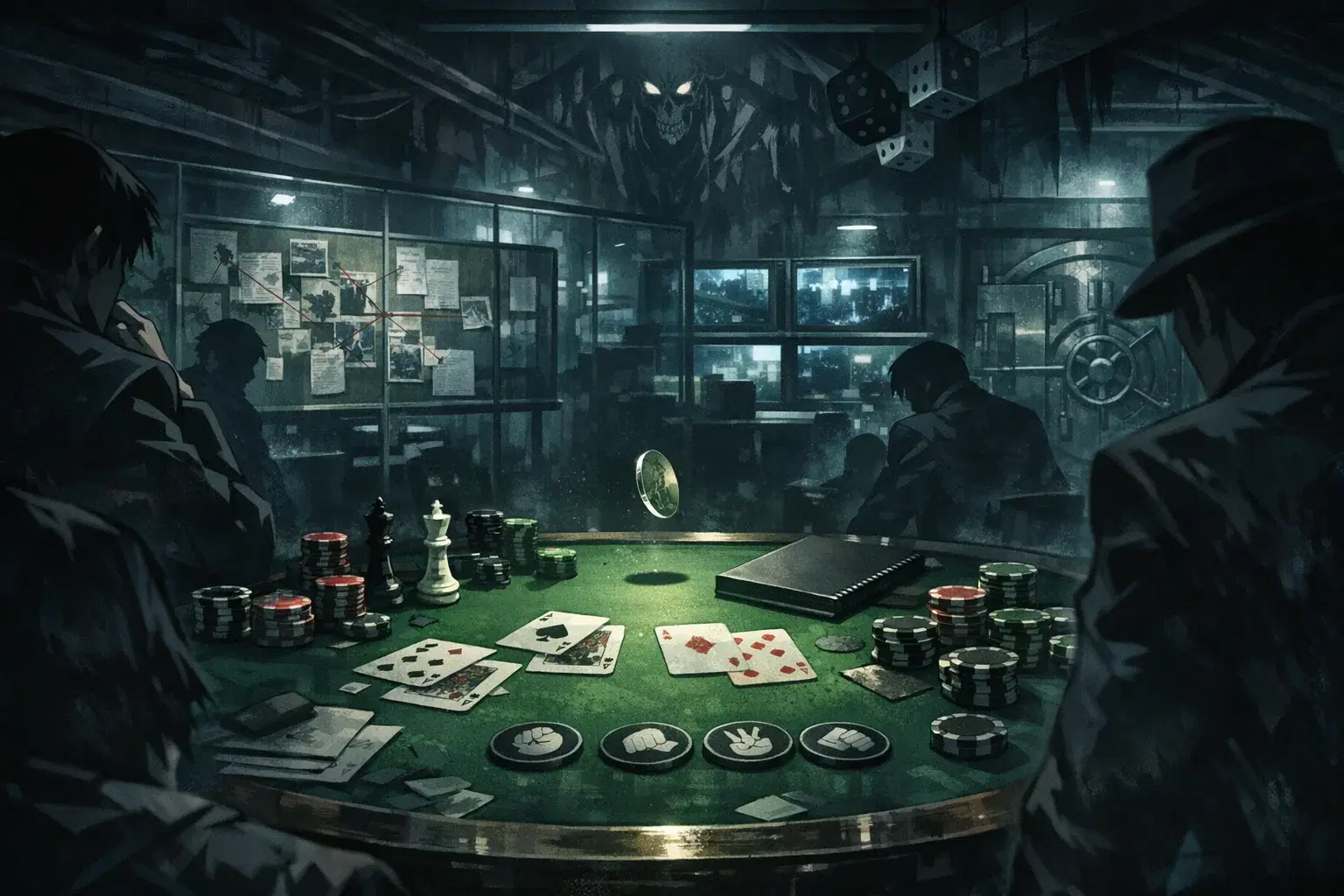
Gambling anime is absurdly entertaining because it understands a truth many action series forget: violence is not the only way to make a scene feel dangerous. A hand of cards, a coin toss, or a modified round of rock-paper-scissors can feel like life-or-death combat when the real battlefield is the player’s mind. That is why the newly confirmed October 5, 2026 premiere of a bank-underworld gambling adaptation matters beyond one seasonal lineup slot. It is a reminder that anime has a uniquely powerful toolkit for turning rules into rituals, wagers into character studies, and hesitation into horror.
The best gambling stories do not need the most complicated games. In fact, they often work better when the game is almost insultingly simple. Kakegurui can explain a classroom betting game in minutes, then spend the rest of the episode on eye contact, humiliation, debt, cheating, status, and desire. The famous debt-gambling tradition that preceded it did the same with restricted rock-paper-scissors: everyone knows the basic mechanics, so the drama shifts from “what is happening?” to “why did they do that?” That shift is the secret sauce. Gambling anime turns a card game into a fight to the death by making every choice a confession.
The Evidence
The core trick of gambling anime is accessibility. If an anime battle depends on a dense power system, the audience must learn the vocabulary before feeling the danger. That can be rewarding, as fans of Hunter x Hunter or Jujutsu Kaisen know, but gambling anime often takes the opposite route. It starts with something you already understand. Rock beats scissors. Higher card wins. Guess the hidden information. Vote correctly. Don’t run out of money.
Then the genre weaponizes everything around the rules.
That is why the debt-gambling classic from Nobuyuki Fukumoto remains such a useful reference point. Its luxury-liner opening game is basically rock-paper-scissors with limited cards, but the setting transforms it. Players are not children killing time; they are debtors trapped in a controlled environment where money, survival, and dignity are collapsing into the same thing. Suddenly, a “simple” decision carries layers: Do you trust the person offering an alliance? Do you spend a valuable card early? Do you bluff confidence when panic is written across your face? The game is easy. The humans are not.
Anime amplifies that tension better than almost any medium. Manga can freeze a face in terror; anime can stretch the silence before the reveal. It can add the hum of a fluorescent room, the scrape of a card on a table, the oppressive rhythm of narration, and the tiny delay before a losing expression breaks. In a physical fight, impact is visible. In gambling anime, impact is interpretive. The punch lands when a character realizes they were understood too well.
Kakegurui pushes this logic in a different direction. Where the debt-gambling school of the genre is grimy, sweaty, and socially desperate, Kakegurui is glossy, eroticized, theatrical, and proudly excessive. Hyakkao Private Academy is not a normal school with gambling added on top; it is a social machine where gambling replaces grades, sports, family names, and morality as the organizing principle. The official game materials for the series include setups like voting rock-paper-scissors, concentration variants, poker twists, and bluffing contests. Most of these are not hard to understand. The thrill comes from how each game exposes the academy’s caste system.
That is the genre’s second trick: gambling externalizes social power. In Kakegurui, losing is not just losing money. It can mean becoming a “house pet,” being publicly degraded, or having your future treated as collateral. The game table becomes a courtroom, a stage, and an execution platform at once. Compare that to Death Note, where two geniuses circle each other through hidden information and deduction. The pleasure is similar: the audience is not merely asking who is stronger, but who has correctly modeled the other person’s mind.
This is also why gambling anime sits naturally beside psychological thrillers like The Promised Neverland, Psycho-Pass, and Code Geass: Lelouch of the Rebellion. These shows understand that suspense becomes sharper when characters are trapped inside systems. A prison, a school, a surveillance state, a battlefield, a rigged casino: the form changes, but the pressure is the same. The protagonist is not simply fighting an opponent. They are fighting incentives, surveillance, scarcity, and their own fear.
The upcoming bank-centered gambling adaptation appears to understand that lineage. Its official premise frames the story around gamblers managed by bankers in a hidden arena beneath a bank, with a rookie banker drawn into the orbit of a mysterious high-stakes player. The production details also suggest the adaptation knows it is selling psychological combat, not just rule diagrams: Seiji Kishi directs, Makoto Fukami handles series composition, Masanori Shino designs the characters, Taku Iwasaki scores the music, and CUE produces the animation. More telling, creator Ikko Tanaka has reportedly joked in official comments that many fan letters say readers do not fully understand the rules but still find it interesting. That is not a weakness. That is practically the genre’s mission statement.
Otaku Insider’s take: the most important part of a gambling anime is not whether the audience can solve the game before the protagonist. It is whether the audience understands what each player believes is at stake. A show can get away with a slightly fuzzy rule set if the emotional math is crystal clear. Who is scared? Who is pretending not to be? Who needs the money? Who needs the humiliation? Who needs to prove they are alive only when everything is on the line?
That last question is where Kakegurui becomes fascinating. Yumeko is not merely good at gambling; she is turned on by uncertainty itself. That makes her different from the rational mastermind archetype in No Game, No Life, where games are often about overwhelming calculation, or the moral judgment framework of Death Parade, where games reveal the soul under pressure. Kakegurui is less interested in clean victory than in appetite. It asks what kind of person smiles when the safe move disappears.
That appetite is why gambling scenes can rival traditional action. In Attack on Titan, danger is gigantic, immediate, and bodily. In Kakegurui, danger is intimate. A student leans forward. A card turns. A face twitches. The scale is smaller, but the emotional violence can be just as loud.
The Counterargument
The obvious criticism is that gambling anime can become ridiculous. The facial expressions go nuclear. The internal monologues stretch a five-second choice into half an episode. The rules can be contrived, the cheating can be melodramatic, and the stakes can escalate from “pay a debt” to “surrender your entire future” with shameless speed. If you prefer grounded drama, the genre’s operatic style can feel like being shouted at by a deck of cards.
That criticism is fair. Not every gambling story earns its intensity, and some lean so hard on shock value that the actual strategy becomes window dressing. Even Kakegurui, for all its style, can divide viewers who want airtight logic over feverish spectacle. The genre’s greatest strength—making everything feel existential—can become exhausting if every round is treated as the end of the world.
But I would argue that excess is not a bug here; it is the aesthetic. Gambling anime is not really trying to simulate a casino night. It is dramatizing capitalism, adolescence, pride, addiction, class anxiety, and the fantasy of beating a rigged system with nothing but nerve. Japan’s real-world conversations around gambling regulation and addiction make that tension even sharper: these stories are entertaining partly because they fictionalize a dangerous impulse in a controlled, symbolic arena.
The key distinction is glamorization versus interrogation. Kakegurui absolutely glamorizes the rush, but it also makes that rush grotesque. Death Parade uses games to judge hidden selves. No Game, No Life turns play into world order. These anime are not all saying the same thing about games, but they share a belief that play reveals truth faster than ordinary conversation.
The Conclusion
Gambling anime is so damn entertaining because it collapses the distance between play and survival. The games are simple by design; the pressure is not. A card game feels like a fight to the death when the wager is identity, status, freedom, or the fragile belief that you are smarter than the person across the table.
That is why the 2026 arrival of a new bank-underworld gambling anime is worth watching as part of a larger tradition, not just as another adaptation announcement. If it understands what made the debt-gambling classic endure and what made Kakegurui explode with theatrical menace, it will not need the most elaborate rules in the room. It will need faces that crack, silences that suffocate, and choices that reveal character.
For Otaku Den readers: what makes a gambling scene work for you—the rules, the mind games, the social stakes, or the sheer unhinged performance? And if Kakegurui, Death Note, No Game, No Life, and Death Parade all scratch different versions of the same itch, which style of psychological warfare hits hardest?
Sources
- [1] TVアニメ『ジャンケットバンク』 (junketbank-anime.com)
- [2] MANGA WE WANT TO SEE ANIMATED RANKING|AnimeJapan 2023 (anime-japan.jp)
- [3] Kaiji (manga) (en.wikipedia.org)
- [4] Kaiji -Ultimate Survivor- | NIPPON TV (ntv.co.jp)
- [5] 逆境無頼カイジ|WORKS|株式会社マッドハウス (madhouse.co.jp)
- [6] 賭ケグルイ 1 | SQUARE ENIX (orig-magazine.jp.square-enix.com)
- [7] 放送情報|TVアニメ「賭ケグルイ」公式サイト (kakegurui-anime.com)
- [8] KAKEGURUI TWIN | Netflix Media Center (media.netflix.com)
- [9] ゲーム解説|TVアニメ「賭ケグルイ」公式サイト (kakegurui-anime.com)
- [10] TV anime “LIAR GAME,” Official Website (liargame-anime.com)
- [11] 'Squid Game' director talks scripts, society and Season 2 (koreajoongangdaily.com)
- [12] Gyakkyō Burai Kaiji: Ultimate Survivor | Kaiji Wiki | Fandom (kaiji.fandom.com)
- [13] Overview of casino regulations - Japan Casino Regulatory Commission (jcrc.go.jp)
- [14] ギャンブル等依存症でお困りの皆様へ | 消費者庁 (caa.go.jp)
- [15] TVアニメ『LIAR GAME』×『ジャンケットバンク』コラボビジュアル解禁! - NEWS - TVアニメ『LIAR GAME』公式HP (liargame-anime.com)
- [16] THE LEGEND OF THE GAMBLER - TETSUYA - TOEI ANIMATION LIST OF WORKS (lineup.toei-anim.co.jp)
- [17] 闘牌伝説アカギ ~闇に舞い降りた天才|WORKS|株式会社マッドハウス (madhouse.co.jp)
- [18] ONE OUTS | NIPPON TV (ntv.co.jp)
- [19] The Greatest Magicmaster's Retirement Plan Anime Reveals Loki Character Visual and Voice Actress (ANIME_CORNER)
- [20] Nia Liston: The Merciless Maiden Anime Reveals 3 More Cast Members (CRUNCHYROLL)
- [21] The Greatest Magicmaster's Retirement Plan Anime Reveals Loki Cast, Character Visual (CRUNCHYROLL)
- [22] Peropero Sparkles Mascot Character Project Gets TV Anime Adaptation (CRUNCHYROLL)
- [23] Revue Starlight: The Movie Returns to Japanese Cinemas on September 9 with Bonus Concert Footage (CRUNCHYROLL)
- [24] Bloodstained: The Scarlet Engagement Game Delayed to 2027 (CRUNCHYROLL)
- [25] Fairies Album Season 3 Japanese Dub Reveals Premiere Date, Teaser Trailer (CRUNCHYROLL)
- [26] Onimusha: Way of the Sword Trailer Previews Intense Boss Fights (CRUNCHYROLL)
- [27] Persona 4 Revival Story Trailer Tunes into the Midnight Channel (CRUNCHYROLL)
- [28] Danganronpa 2x2 Switch 2 Physical Release Will Now Be Game-Key Card Only (CRUNCHYROLL)
- [29] Millennium Family Anime Casts Katsuyuki Konishi as Eldest Son (CRUNCHYROLL)
- [30] The World's Strongest Witch Anime's New Video Unveils More Cast & Staff, Theme Songs (ANN)
- [31] Millennium Family TV Anime Casts Katsuyuki Konishi (ANN)
- [32] My Crush's Crush Manga Gets TV Anime (ANN)
- [33] THE RIBBON HERO Anime Film Plans 2-Week Limited Theatrical Run in September (CRUNCHYROLL)
Written by Ranen with AI support — Ranen picks every story, shapes the angle, and reviews each article before it's published. Learn more in our editorial policy.