The Take
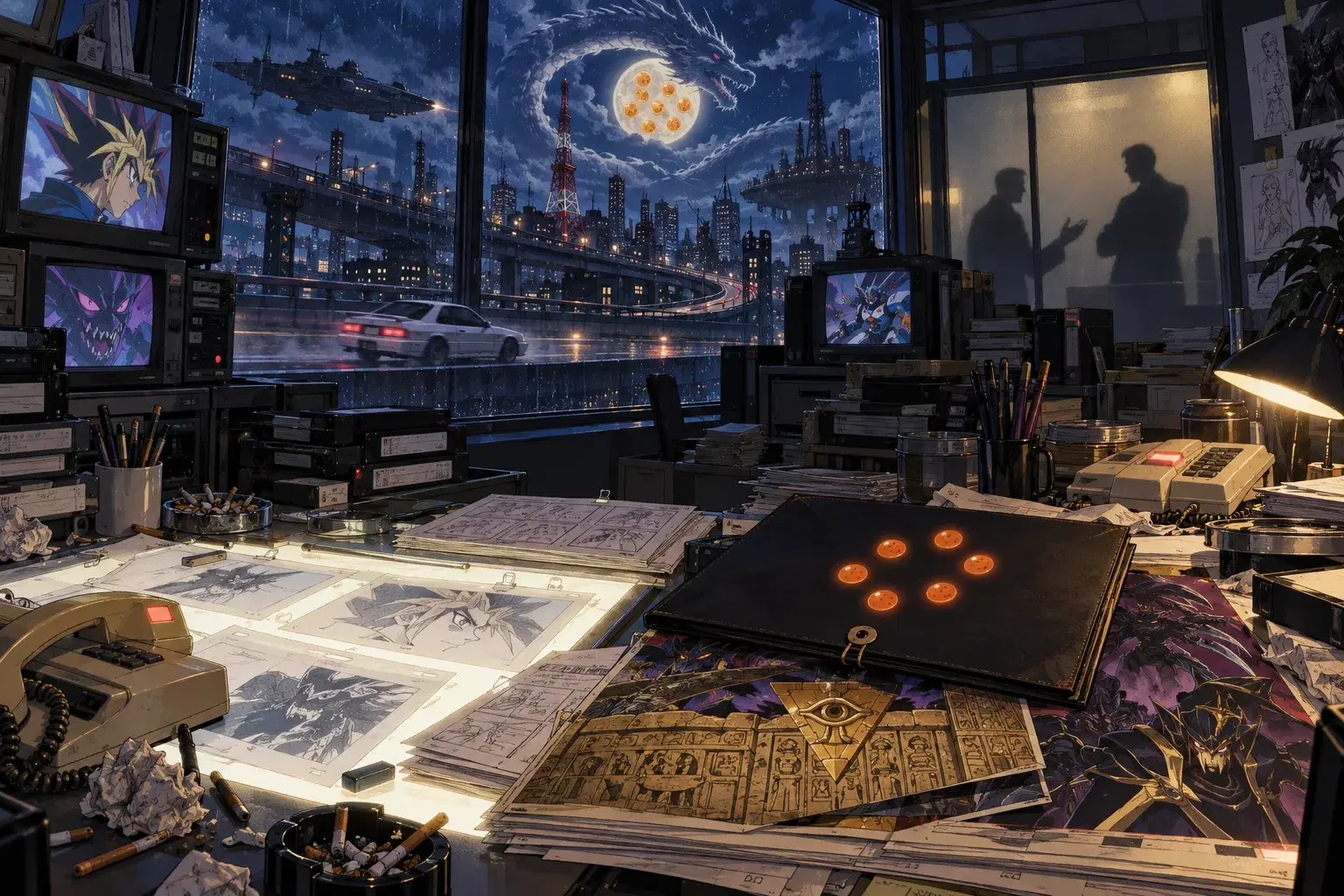
The survival of Yu-Gi-Oh! was not simply a case of executives recognizing an overlooked hit. It was an exercise in corporate leverage. According to veteran producer Yoshiro Kataoka, Weekly Shonen Jump editor-in-chief Kazuhiko Torishima broke a rights deadlock by threatening Toei Animation’s secondary-use rights to Dragon Ball. That extraordinary move allegedly cleared the way for the separate TV Tokyo adaptation launched in 2000—and, ultimately, the version that transformed the property into an international entertainment business.
Otaku Insider’s take: Torishima’s ultimatum mattered, but the threat alone did not create the phenomenon. It rescued the opportunity. The decisive follow-up was rebuilding the anime around a card game that viewers could understand, imitate and buy. This story therefore exposes two truths about the anime industry: a promising work can be trapped by contracts even after its original production ends, and saving an intellectual property means little unless the next adaptation understands what its audience actually wants.
It also makes the 1998 series more historically important than its reputation suggests. Yu-Gi-Oh! was not merely a forgotten false start. Its failure revealed what the property had not yet become—and triggered the battle over who would be allowed to try again.
The Evidence
Toei’s Yu-Gi-Oh! aired on TV Asahi from April 4 to October 10, 1998, running for 27 episodes. Kataoka says the Dentsu-handled broadcast ended because its television ratings were unsatisfactory. No concrete average or episode-by-episode audience figures for that run have surfaced in the cited material, so “poor ratings” should be treated as Kataoka’s qualitative account rather than a newly recovered statistical record.
Timing appears to have been the cruel part. Kataoka recalls that the manga’s Weekly Shonen Jump reader-survey performance was becoming exceptionally strong just as the television production was ending. In other words, the anime may have arrived before the source material had fully established its most marketable identity. The early story was broader and darker than the card-battle image later associated with the property, making the 1998 adaptation a snapshot of a franchise still discovering its center.
That distinction matters in a year remembered for sharply defined productions such as Cowboy Bebop, Serial Experiments Lain, Cardcaptor Sakura and Initial D First Stage. Those anime presented viewers with immediately legible identities: space-western cool, technological alienation, magical-girl warmth and street-racing intensity. Yu-Gi-Oh!, by contrast, was adapting a manga whose long-term commercial engine was only beginning to emerge.
Torishima nevertheless saw enough momentum to demand another attempt. He was not an ordinary editor making an optimistic pitch. He had worked closely on Dragon Ball, became Weekly Shonen Jump’s editor-in-chief in 1996 and understood the power of connecting manga, television and merchandise. Kataoka says Torishima asked him and Asatsu-DK to find a TV Tokyo time slot and sponsors for a new production.
The obstacle was not merely Toei’s lack of enthusiasm. Existing arrangements reportedly left TV Asahi with approximately two and a half years of rerun rights, while Toei retained authority over merchandising and other secondary uses. That meant a discontinued television series could still block a replacement. Audience demand, editorial confidence and sponsor interest were not enough if the relevant companies would not release or accommodate their contractual positions.
According to Kataoka, Toei rejected the proposal. Torishima then allegedly threatened to halt its secondary-use rights for Dragon Ball. The wording is crucial: this was not a threat to transfer ownership of the entire property or erase every Toei connection. It concerned the valuable downstream rights attached to a franchise whose animated footprint already included Dragon Ball Z and, by the late 1990s, Dragon Ball GT. Even a narrower secondary-rights threat could carry enormous financial weight.
The pressure apparently worked. The replacement adaptation premiered on TV Tokyo on April 18, 2000 and eventually reached 224 episodes. More importantly, its creative strategy aligned television with the physical card game that Konami had begun selling in Japan in February 1999. Kataoka says the production was instructed to teach viewers how to win, with card-game specialists brought into the process. That approach turned matches into entertainment, tutorials and product demonstrations simultaneously.
The historical performance data show the scale of the result. A March 9, 2004 joint release from Shueisha, TV Tokyo and ADK/NAS reported a 7.5% average household rating in the Tokyo area across the measured period from April 2000 through March 3, 2004. It also said the program had been broadcast in more than 50 countries and that 27 million manga volumes were in circulation through volume 36. Those are historical distribution figures, not evidence of present-day worldwide streaming availability, but they demonstrate how dramatically the second television strategy outgrew the first.
The newly circulating account itself also needs a date label. The events concern the transition from 1998 to 2000, while Kaishi Professional University published the relevant installment of Kataoka’s oral history on May 13, 2026. An English excerpt appeared on October 21, followed by wider English-language reporting on October 26 and 27. The story is newly prominent, not newly discovered at the moment the business dispute occurred.
The Counterargument
The obvious objection is that the most explosive detail rests on one retrospective account. Kataoka says he learned about the confrontation afterward; he did not claim to have personally witnessed Torishima deliver the ultimatum. No publicly located contemporaneous document or confirming statement from Torishima, Toei or TV Asahi establishes the exchange word for word. It is therefore more responsible to say the threat occurred “according to Kataoka” than to present it as an independently proven transcript.
It would also be unfair to cast Toei as a cartoon villain trying to destroy Yu-Gi-Oh!. A company declining to continue a low-rated television project is normal business judgment, while protecting rerun and secondary-use rights is standard contractual behavior. Toei even produced a theatrical short based on the property after the television run, demonstrating that it had not instantly abandoned every possible use.
There is also no way to prove the counterfactual implied by saying the franchise “only” survived because of Dragon Ball. The manga was gaining momentum, and Konami’s card game created a powerful commercial incentive for somebody to resolve the impasse eventually. A different negotiation might have produced another outcome.
Even so, those caveats do not make Kataoka’s account trivial. Rights windows can stall adaptations for years, and delay is especially dangerous for youth-oriented properties dependent on synchronized manga, television, toys and games. Torishima’s alleged intervention did not guarantee success, but it appears to have accelerated the one thing the property urgently needed: permission for a different production structure to attempt a different strategy.
The Conclusion
The real lesson of the 1998 Yu-Gi-Oh! anime is that cancellation and death are not the same thing. The first adaptation ended, yet the underlying property was becoming more valuable. What nearly buried its next chance was the gap between creative momentum and contractual control. Torishima’s alleged threat involving Dragon Ball was effective because it converted Shueisha’s editorial conviction into leverage that Toei could not easily ignore.
But leverage opened the door; reinvention carried the property through it. The 2000 adaptation succeeded by treating the card game as a system viewers could learn rather than a decorative plot device. That combination—aggressive rights negotiation followed by sharper product design—is why this episode deserves more than a sensational headline.
Otaku Insider’s take: anime history is often written as a sequence of hits created by visionary artists. This account reminds us that some hits exist because an executive was willing to challenge an entrenched rights arrangement, while producers were willing to rebuild the concept around a clearer audience experience. Whether Torishima’s tactics were admirable, excessive or both, the outcome altered the course of anime merchandising history. The question for fans is uncomfortable but fascinating: how many other potential classics never received their second chance because nobody had comparable leverage?
Sources
- [1] kaishi-pu.ac.jp (kaishi-pu.ac.jp)
- [2] テレビ東京・あにてれ 遊戯王 デュエルモンスターズ (tv-tokyo.co.jp)
- [3] TORISHIMA Kazuhiko - 文化庁メディア芸術祭 - JAPAN MEDIA ARTS FESTIVAL (bunka.go.jp)
- [4] 「遊戯王カードゲーム」 25周年記念プロジェクトが始動! | 株式会社コナミデジタルエンタテインメント (konami.com)
- [5] 東映アニメーション株式会社の60周年記念サイト アニメといえば、東映アニメーション! (60th.toei-anim.co.jp)
- [6] YU-GI-OH - TOEI ANIMATION LIST OF WORKS (lineup.toei-anim.co.jp)
- [7] CARD HISTORY | 遊戯王OCGデュエルモンスターズ 20th ANNIVERSARY 特設サイト (yugioh-card.com)
- [8] Source (tv-tokyo.co.jp)
- [9] Excerpt of Interview with Kataoka Yoshiro: The Beginnings of Yu-Gi-Oh! Duel Monsters | YGOrganization (ygorganization.com)
- [10] How Yu-Gi-Oh! Was Saved By A Threat To Pull Dragon Ball Rights (otakumantra.com)
- [11] Toei's Dragon Ball Rights Threatened For Trying To Can Yu-Gi-Oh (kotaku.com)
- [12] 株式会社ぎゃろっぷ | 作品紹介ページ (anime-gallop.co.jp)
- [13] 遊☆戯☆王 : 作品情報・キャスト・あらすじ - 映画.com (eiga.com)
- [14] Yu-Gi-Oh! - Wikidata (wikidata.org)
- [15] As a Reincarnated Aristocrat, I'll Use My Appraisal Skill to Rise in the World Season 3 Anime Previews Fujimiya Arc in New Trailer (CRUNCHYROLL)
- [16] Goddess of Victory: Nikke Game Gets New Manga Adaptation (ANN)
- [17] Patlabor EZY Anime Gets Novelization in 2027 (ANN)
- [18] Interview: Corey Wilder at Anime Central (ANIME_CORNER)
- [19] Are You a Landmine, Chihara-san? Anime Music Project Releases 4th Music Video "Melancholic" (CRUNCHYROLL)
- [20] Konomi Suzuki Drops Even Though I'm a Super Timid Noble Girl, I Accepted the Bet from My Cunning Fiancé Anime Opening Song Music Video (CRUNCHYROLL)
- [21] Anisong Unit ClariS Releases VERTEX FORCE Anime Opening Song Music Video (CRUNCHYROLL)
- [22] Star Detective Precure! Anime Film Shares Action-Packed Opening Footage (CRUNCHYROLL)
- [23] Lulutto Lilly, Sabagebu! Anime Battle Crabs in Second Crossover (CRUNCHYROLL)
- [24] King’s Proposal Anime Reveals Main Cast, Teaser Visual, 2027 Premiere Date (ANIME_CORNER)
- [25] Yen Press Licenses Cross-Dressing Villainess Cecilia Sylvie: Extra Round!, 'And Thus, the Wizard Noi Garené Became a Bride 100 Years Later,' 8 More Titles (ANN)
- [26] BanG Dream! It's MyGO!!!!! / Ave Mujica – The Die is Cast – Sequel Anime Shares New Teaser (CRUNCHYROLL)
- [27] BanG Dream! It's MyGo!!!!! // Ave Mujica Anime's 2nd Teaser Unveils January 8 Debut (ANN)
- [28] 'Ousama no Propose' Reveals Lead Cast, 2027 Debut (MAL_RSS)
- [29] King's Proposal Anime Unveils 2027 Debut, Lead Cast, Teaser Visual (ANN)
Written by Ranen with AI support — Ranen picks every story, shapes the angle, and reviews each article before it's published. Learn more in our editorial policy.