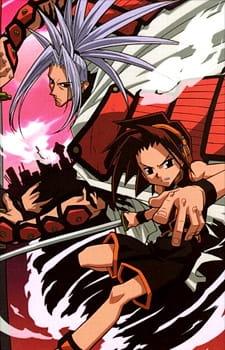
Shaman King
シャーマンキング
- Action
- Adventure
- Supernatural
- Mythology
- Reincarnation
- Super Power
- Episodes
- 64
- Duration
- 23 min per ep
- Aired
- Jul 4, 2001 to Sep 25, 2002
- Status
- Finished Airing
Synopsis
Every five hundred years, Tokyo becomes the stage for the Shaman Fight, a tournament where shamans—people capable of commanding spirits—battle for the right to be crowned Shaman King. The winner alone can commune with and wield the Great Spirit, a power vast enough to change the world according to their will.
One night, Manta Oyamada crosses paths with his laid-back classmate You Asakura, who casually invites him to stargaze—only for Manta to realize You’s “friends” are ghosts from a nearby cemetery. Thanks to a rare sixth sense that lets him see spirits, Manta earns You’s trust, and their connection deepens when Manta is attacked by a local gang. You steps in with the aid of Amidamaru, a samurai spirit tied to a grave the gang leader desecrated, drawing Manta further into the hidden world of spirits—and toward the Shaman Fight You intends to win.
Otaku Consensus
Xebec’s 2001 Shaman King endures as a personality-rich shounen: Seiji Mizushima’s direction, the Japanese voice cast, and the mix of ghost comedy with tournament combat give it more identity than its mid-2000s reputation suggests. Its reputation is capped by the same issues critics keep returning to: uneven pacing, dated cultural handling, and an adaptation that had to break away from an unfinished manga rather than deliver a definitive version.
Why You Should Watch
Watch the 2001 Shaman King if you want a battle shounen that scratches the same itch as Yu Yu Hakusho’s spiritual duels and early Naruto’s rival-friend energy, but with a looser, more supernatural road-trip flavor. Its appeal is not precision plotting; it is the specific texture of early-2000s TV anime: episodic character encounters, offbeat spirit designs, big emotional declarations, and a hero whose calmness pushes against the usual screaming-protagonist template. It is especially rewarding for viewers who enjoy seeing how an older adaptation solves the problem of an unfinished manga, because the second half becomes its own historical artifact. If the 2021 version felt too compressed, this 64-episode run gives the cast and atmosphere more breathing room.
Key Characters
- YYou Asakura(VA: Yuuko Satou)
You stands out because his relaxed, almost frictionless attitude makes him feel unlike the usual hot-blooded shounen lead, and Yuuko Satou leans into that unhurried warmth.
- AAnna Kyouyama(VA: Megumi Hayashibara)
Anna is remembered less as a conventional love interest than as the series’ command center, with Megumi Hayashibara giving her severity a sharp comic edge.
- HHao Asakura(VA: Minami Takayama)
Hao’s appeal comes from his unnervingly calm authority, and Minami Takayama’s performance makes him the character most associated with the show’s reincarnation and destiny themes.
- AAmidamaru(VA: Katsuyuki Konishi)
Amidamaru gives the action a samurai-code texture, turning fights into tests of loyalty and discipline rather than simple power escalation.
What Makes It Stand Out
- 1
The 2001 series is a 64-episode Xebec production, giving it far more space than the later 2021 reboot, which is frequently criticized in fan discussion for feeling condensed and rushed.
- 2
Because it aired while Hiroyuki Takei’s manga was still ongoing, the anime becomes an alternate adaptation rather than a straight completion; viewer reviews consistently identify the first half as more episodic and the second half as the point where it moves in its own direction.
- 3
Seiji Mizushima directed the series, with Katsuhiko Koide on series composition and Akio Takami on character design, giving the show a distinctly early-2000s TV-shounen rhythm rather than the tighter seasonal pacing expected today.
- 4
Its thematic spread is unusually broad for a tournament shounen: AniList tags it not only as Ghost and Super Power, but also Mythology, Reincarnation, Environmental, and Indigenous Cultures.
- 5
The Japanese cast is a major part of its legacy, placing Yuuko Satou, Megumi Hayashibara, Minami Takayama, Katsuyuki Konishi, and Inuko Inuyama around the central ensemble.
Fun Facts & Trivia
- Fun fact 1
- The anime aired from July 4, 2001 to September 25, 2002, a production window that overlapped with the manga’s ongoing publication and directly shaped its anime-original trajectory.
- Fun fact 2
- Hiroyuki Takei is credited as the original creator, while Naoko Marukawa and Hidefumi Morimi receive Literary Arts credits alongside Katsuhiko Koide’s Series Composition role, a more granular writing-credit breakdown than many fans notice.
- Fun fact 3
- A Black Nerd Problems retrospective rated the original anime 6.5/10, praising its action, animation, voice acting, and theme song while singling out inconsistent pacing and racist elements as liabilities.
- Fun fact 4
- The 2021 reboot is often discussed as the manga-completion counterpart, but the available fan commentary frames it as stronger for veterans than newcomers because its pacing and animation can feel compressed.
- Fun fact 5
- Across databases, the original sits in the well-liked legacy zone rather than the canonized-masterpiece tier: MAL lists it at 7.73 from 203,948 votes, while AniList records a 74/100 score and 1,402 favourites.
Studios
- Xebec