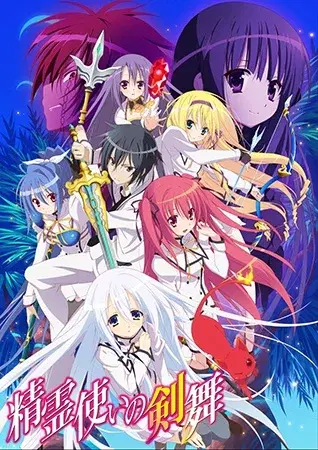
World Break: Aria of Curse for a Holy Swordsman
聖剣使いの禁呪詠唱〈ワールドブレイク〉 (Seiken Tsukai no World Break)
- Action
- Fantasy
- Romance
- Harem
- Reincarnation
- School
- Urban Fantasy
- Episodes
- 12
- Duration
- 24 min per ep
- Aired
- Jan 12, 2015 to Mar 30, 2015
- Status
- Finished Airing
Synopsis
*World Break: Aria of Curse for a Holy Swordsman* is set at Akane Private Academy, where teenagers who retain memories of past lives are trained in “Ancestral Arts” to protect humanity from sudden attacks by monsters known as Metaphysicals. These defenders, called Saviors, are divided into two paths: Kurogane, who channel prana to manifest weapons for close combat, and Kuroma, who wield magic.
On the first day of the school year, Moroha Haimura’s past comes rushing back in unexpected ways. He meets Satsuki Ranjou, who claims she was his younger sister in a previous life when he lived as a heroic prince famed for overwhelming swordsmanship. Soon after, Shizuno Urushibara approaches him with a very different connection—she remembers another lifetime in which Moroha was a dark lord of devastating magic who rescued her from slavery. Caught between two histories and the demands of the present, Moroha must navigate what it means to carry multiple lives while searching for a future of his own.
Otaku Consensus
World Break earns interest through its dual-past-life romantic hook, theatrical spell-casting, and brisk commitment to overpowered-school-battle spectacle; the opening episode’s unusually memorable folding-chair sequence also shows flashes of playful direction. Its 12-episode adaptation is most often faulted for treating reincarnation as a shortcut to romance and power rather than exploring its psychological implications, while inconsistent animation and haphazard plotting undermine the stronger ideas. Genre devotees frequently embrace that excess as guilty-pleasure entertainment, but critics found the supporting cast and fan service too formulaic.
Why You Should Watch
Watch World Break if you want the compressed pleasures of a mid-2010s battle-school harem: rapid power escalation, elaborate spoken incantations, sword clashes, competing heroines, and little patience for restraint. It scratches the same itch as Infinite Stratos and Absolute Duo, but its romantic rivalry has an extra wrinkle: the central relationships arrive with incompatible emotional histories rather than developing from ordinary classroom attraction. That gives the banter and jealousy a more peculiar charge, even when the writing declines to examine reincarnation deeply. The series is best approached as energetic comfort food for viewers who value transformations, magical spectacle, an overwhelmingly capable male lead, and unabashed fan service over polished sakuga or intricate ensemble development. Its complete 12-episode run also makes it a quick, self-contained genre sampler.
Key Characters
- MMoroha Haimura(VA: Kaito Ishikawa)
Moroha stands out less for conventional underdog growth than for embodying two incompatible power fantasies at once, with Kaito Ishikawa supplying the composed authority associated with formidable light-novel leads.
- SSatsuki Ranjou(VA: Ayana Taketatsu)
Satsuki supplies the central trio’s loudest comic and romantic friction, turning an inherited familial attachment into an intentionally awkward challenge to ordinary harem conventions.
- SShizuno Urushibara(VA: Aoi Yuuki)
Shizuno became an early critical point of interest because her restrained presence suggested more potential than a disposable secondary heroine, with Aoi Yuuki giving her an effective contrast to Satsuki’s volatility.
What Makes It Stand Out
- 1
The romance is structurally built around two conflicting remembered relationships rather than a single shared history, allowing the series to begin with emotional claims that most harems spend an entire season establishing.
- 2
Spell-casting is staged as a performance in itself, with lengthy verbal incantations and transformation imagery receiving enough emphasis that reviewers singled it out even while criticizing the broader animation quality.
- 3
Diomedéa’s production alternates swordplay and magic instead of assigning the protagonist only one combat vocabulary, visually reinforcing his unusual position within the academy’s otherwise divided power system.
- 4
The first episode contains an animated sequence involving folding chairs that Comic Bastards specifically praised, an eccentric piece of physical staging that briefly distinguishes the direction from routine battle-school introductions.
- 5
The 12-episode adaptation favors rapid escalation and immediate harem expansion over sustained examination of past-life memory, a structural choice that explains both its guilty-pleasure following and its most persistent criticism.
Fun Facts & Trivia
- Fun fact 1
- The anime adapts Akamitsu Awamura’s original work, while Refeia created the source character designs; Masakazu Ishikawa translated those designs for animation.
- Fun fact 2
- Takayuki Inagaki directed the series, with Hiroshi Yamaguchi overseeing series composition and Keisuke Yanagi handling editing.
- Fun fact 3
- Mio Inoue wrote episodes 3, 4, 7, and 8, giving her responsibility for a continuous middle stretch rather than isolated installments.
- Fun fact 4
- Akihiko Oka contributed key animation to episode 7, one of the few episode-specific animation credits identified in the available staff data.
- Fun fact 5
- The opening theme was performed by petit milady, the voice-actor unit formed by Aoi Yuuki and Ayana Taketatsu, who also voice Shizuno and Satsuki respectively.
Studios
- Diomedéa