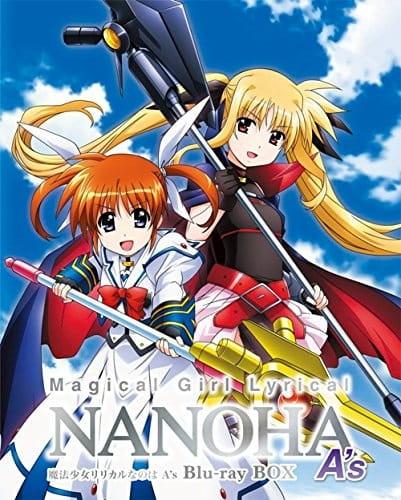
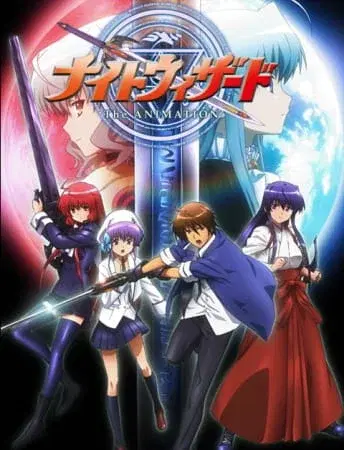
Magical Girl Lyrical Nanoha A's
魔法少女リリカルなのは エース (Mahou Shoujo Lyrical Nanoha A's)
- Action
- Comedy
- Drama
- Mahou Shoujo
- Episodes
- 13
- Duration
- 25 min per ep
- Aired
- Oct 2, 2005 to Dec 25, 2005
- Status
- Finished Airing
Synopsis
After the Jewel Seeds incident is resolved, Nanoha Takamachi slips back into ordinary days—now punctuated by early-morning magic training. She keeps in touch through video messages with Fate Testarossa and the Arthra’s crew, looking forward to the moment they can meet again in person. That calm is shattered when Raising Heart suddenly senses danger and warns Nanoha of an imminent attack.
The assailant is Vita, a self-proclaimed Belka Knight wielding an intelligent device powered by a strange cartridge system, and her overwhelming strength quickly corners Nanoha. The Space-Time Administration Bureau arrives in time to intervene, revealing that Vita is not alone: Shamal, Signum, and Zafila are also targeting mages to siphon their power. Their goal is to complete the Book of Darkness, a Lost Logia—leaving the question of what they intend to do with it hanging ominously over Nanoha’s next battle.
Otaku Consensus
Magical Girl Lyrical Nanoha A's is widely treated as the franchise’s first major leap: Keizou Kusakawa’s brisk direction, Masaki Tsuzuki’s tighter 13-episode script, and Seven Arcs’ weaponized take on mahou shoujo combat turn a sequel into the series’ defining entry. Its MAL 7.96 and AniList 78/100 reception reflect strong fan affection for the Book of Darkness arc’s pacing and emotional payoff, with the main caveat being that the Bureau and Belka lore can feel compressed for viewers not already invested in Nanoha’s first season.
Why You Should Watch
Watch A's if you want magical girls treated less like icons of purity and more like aerial duelists in a sci-fi operations drama. It scratches the same action itch as Precure’s high-impact fights, but swaps monster-of-the-week rhythm for serialized tactics, intelligent weapons, military briefings, and emotionally loaded rivalries. The appeal is specific: child protagonists, urban fantasy, space-bureau procedure, talking devices, cartridge-powered attacks, and a primarily female cast without the nihilistic deconstruction that later defined darker mahou shoujo. At 13 episodes, it wastes little time, and the Nana Mizuki opening plus Yukari Tamura ending give the season a distinctly mid-2000s otaku-anime identity. If the first Nanoha showed the concept, A's is where the franchise’s battle-magic vocabulary locks into place.
Key Characters
- NNanoha Takamachi(VA: Yukari Tamura)
Nanoha is compelling because fans read her less as a passive magical-girl heroine and more as a disciplined young combatant whose kindness is backed by unnervingly precise firepower.
- FFate Testarossa(VA: Nana Mizuki)
Fate’s popularity comes from the way her quiet restraint contrasts with the series’ loud beam-and-device spectacle, making her presence feel emotionally charged even before a fight starts.
- VVita
Vita stands out as the Belka Knight who immediately changes the show’s combat texture, bringing brute-force cartridge tactics into a franchise previously associated with cleaner Mid-Childa-style spellcasting.
- SSignum
Signum is remembered as A's aristocratic duelist figure, the kind of opponent whose swordplay gives the season its sharpest sense of martial ceremony.
What Makes It Stand Out
- 1
Seven Arcs pushes the mahou shoujo format toward action choreography built around weapons, aerial spacing, and device mechanics rather than transformation spectacle alone. The Belka cartridge system gives fights a reload-and-impact rhythm that became central to how fans talk about Nanoha combat.
- 2
The season’s 13-episode structure is unusually tight for a sequel that expands the setting into Bureau operations, Lost Logia consequences, and a rival magical system. That compression is a strength in momentum and also the source of the most common criticism: the lore arrives fast.
- 3
Masaki Tsuzuki handles both original creator credit and script, giving A's a more unified authorial voice than many multimedia magical-girl projects. The result is a season that feels engineered as a direct escalation rather than a loose follow-up.
- 4
The AniList tag profile is unusually hybrid for a mahou shoujo title: Magic, Henshin, Urban Fantasy, Space, Swordplay, Spearplay, Animals, Kemonomimi, and Orphan all register as notable identifiers. That mix explains why A's often attracts viewers from action-fantasy and sci-fi fandoms, not only traditional magical-girl audiences.
- 5
Hiroaki Sano’s music, Toshiki Kameyama’s sound direction, and the theme-song pairing of Nana Mizuki on the opening with Yukari Tamura on the ending give the season a strong audio signature. For longtime fans, those vocals are inseparable from Nanoha’s mid-2000s identity.
Fun Facts & Trivia
- Fun fact 1
- A's aired as a compact fall 2005 TV run from October 2 to December 25, finishing on Christmas Day with 13 episodes.
- Fun fact 2
- Keizou Kusakawa did not only direct the series; the staff data also credits him as episode director for the opening, ending, and episode 1, giving the season’s first impression unusually direct oversight from the main director.
- Fun fact 3
- The core production credits place Yasuhiro Okuda on character design, Kazuhiko Seki on editing, Toshiki Kameyama as sound director, and Hiroaki Sano on music, with Seven Arcs as the animation studio.
- Fun fact 4
- Its database footprint shows a strong cult-classic profile rather than broad mainstream saturation: MAL lists a 7.96 score from 35,508 votes, rank #813, and popularity #3021, while AniList records a 78/100 score and 401 favourites.
- Fun fact 5
- The theme-song credits double as a snapshot of the franchise’s star power: Nana Mizuki performs the opening theme, while Yukari Tamura performs the ending theme.
Studios
- Seven Arcs
No community data yet. Be the first to add Magical Girl Lyrical Nanoha A's to your list!