The Take
No, AI animation is not going to replace animators — at least not in the way the loudest tech evangelists and doom-posters imagine. A prompt box will not suddenly produce the next Ping Pong the Animation, Violet Evergarden, or Mob Psycho 100 with the taste, timing, acting, revision culture, and visual intelligence that define great anime. But that comforting answer comes with a warning: AI does not need to replace every animator to damage the profession. It only needs to replace enough tasks, weaken enough bargaining power, and normalize enough “good enough” shortcuts that the bottom of the production ladder becomes even more unstable.
Otaku Insider’s take: the real question in 2026 is not whether AI can make anime. It can make fragments that look like anime. The question is whether the industry will use those fragments to support artists — or to squeeze them harder in a market that is already booming financially while many workers remain underpaid and overworked.
The Evidence
The anime business is not experimenting with AI because the medium is failing. It is experimenting with AI because anime is too successful for its current labor model. The Association of Japanese Animations has tracked an industry that has expanded dramatically, with recent reporting around the 2024 market putting the sector at roughly ¥3.84 trillion and international revenue continuing to play an enormous role. Global appetite for anime like Demon Slayer: Kimetsu no Yaiba, Jujutsu Kaisen, Spy x Family, Attack on Titan, One Piece, and Chainsaw Man has made Japanese animation one of the world’s most valuable entertainment exports.
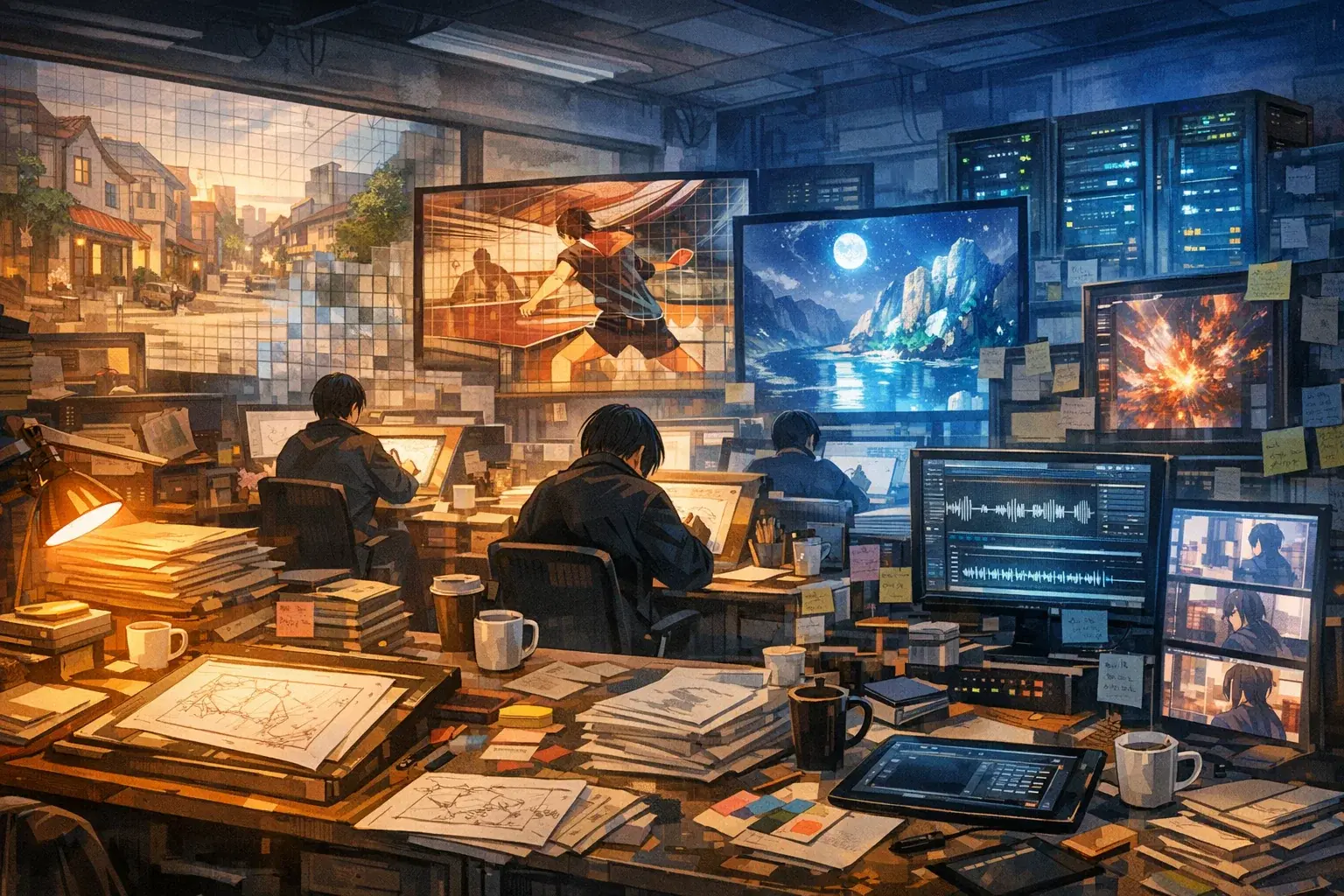
That boom has not translated cleanly into healthy working conditions. NAFCA’s 2024 working-conditions survey reported average monthly working hours of 219, a median of 225, and a maximum of 336 among respondents. It also found the most common hourly-equivalent pay band was ¥600–¥800, with a median of ¥1,111. Those numbers matter more than any glossy AI demo. When executives say AI can address “labor shortages,” fans should ask: shortages caused by what? A lack of human beings who can draw? Or a lack of sustainable pay, scheduling, training, and credit structures?
The evidence so far points to AI replacing pieces of the pipeline, not the animator as a creative role. Toei Animation and Preferred Networks tested AI-assisted background workflows using a tool that converted real-world scenery photos into anime-style backgrounds, with Toei saying preprocessing time was reduced to about one-sixth. That is the strongest case for responsible AI: remove repetitive preprocessing, then let background artists spend more time on design, atmosphere, and final retouching.
Netflix’s 2023 collaboration with WIT Studio on an AI-assisted short became a flashpoint because AI-generated backgrounds were framed partly as a response to labor shortages. The backlash was not just anti-technology reflex. It was a trust issue. Fans and artists looked at an industry with brutal hours and low wages and heard, “Instead of fixing the labor model, we found a tool that may reduce the need for some labor.” That is why the same technical experiment can be read as either support or exploitation depending on transparency, compensation, consent, and credit.
NAFCA’s 2023 AI opinion survey complicates the easy narrative that anime workers simply reject new tools. With 3,854 responses, the survey found anime-industry respondents were more optimistic about AI than non-industry respondents. At the same time, 57% of anime-industry respondents favored full or partial regulation, and many raised concerns about unclear training data rights. That is not technophobia. That is labor intelligence. Workers understand that tools can help, but they also understand that unregulated tools can devalue the very human art they are trained to imitate.
Recent controversies show that audiences are becoming more sensitive, too. In 2026, a major studio apologized after generative AI use was discovered in part of an opening sequence for a popular adaptation, and the disputed material was reportedly replaced or redrawn. Around the same period, other prestige projects publicly emphasized that they used no generative AI or that their work was fully hand-drawn after fan suspicion. That tells us something important: “human-made” is becoming a market signal. For the same reason fans celebrate the expressive looseness of Kill la Kill, the theatrical impact of Demon Slayer: Kimetsu no Yaiba - The Movie: Mugen Train, or the tactile cinematic weight of A Silent Voice, they increasingly care about the production ethics behind the image.
Legally, the ground is still moving. Japanese government bodies have published guidance around copyright and generative AI, while the Agency for Cultural Affairs continues to clarify how copyright principles apply. METI has also released a guidebook on generative AI use in content production. Meanwhile, Japanese rights holders represented through CODA have challenged unauthorized training and outputs involving major AI video systems. OpenAI’s Sora consumer app and web experiences were later discontinued, with help materials stating the web/app product ended in April 2026 and API access was scheduled to end in September 2026. Whether one reads that as a business pivot, a legal-pressure story, or both, the lesson is the same: AI video is not entering anime in a rights-free vacuum.
Technically, AI also remains far from solving what makes anime production hard. Research into generative cel animation, long-form animation planning, and anime-oriented video models is advancing quickly, but “a convincing clip” is not the same as an episode. Anime needs continuity across shots, acting choices that match character psychology, layouts that serve staging, compositing that respects mood, and corrections that align hundreds of cuts into one visual language. A model can imitate the surface of Your Name.; it cannot yet replace the directorial decision-making that makes a sky, a pause, or a hand movement emotionally legible.
The danger zone is therefore not the masterpiece. It is the disposable layer: low-budget promotional shorts, quick-turnaround web ads, background drafts, rough in-betweens, cheap localization, automated merchandise supervision, and short-form social content. That is where AI can become “good enough” for committees under pressure. And if “good enough” becomes the standard for entry-level work, fewer young artists get the repetitions they need to become the key animators, animation directors, and series directors of tomorrow.
The Counterargument
The strongest counterargument is simple: anime has a capacity problem, and AI may be the only realistic way to relieve pressure. Fans want more shows, more simulcasts, faster localization, cleaner home releases, and constant franchise content. Studios are juggling global platforms, production committees, merchandise pipelines, and overseas demand. If AI can automate coloring checks, generate background bases, assist in-betweening, flag continuity errors, or help small teams produce pilots, why reject it?
That argument deserves respect. A responsible toolchain could make the industry healthier. If AI reduces unpaid overtime, removes drudge work, helps small studios pitch original projects, or lets artists focus on higher-value creative decisions, then it should be welcomed. Nobody should romanticize exhaustion as artistic purity. The history of anime is also a history of tools: digital coloring, 3D layouts, compositing software, CG crowds, and hybrid pipelines. Fans who love Land of the Lustrous would be making a category error if they claimed technology and artistry cannot coexist — but that title is not in our current Otaku Den reference set, so let’s put it another way: the medium has always evolved through production technique.
The problem is that “AI as assistance” and “AI as replacement” can look identical from outside unless studios disclose what is being used, where the training data came from, who approved it, and how workers are compensated. If an animator uses AI to test a background palette, that is one thing. If a company trains on unlicensed artwork, cuts junior roles, and markets the result as innovation, that is another. The counterargument only works if AI adoption is paired with labor reform, rights clarity, and transparency. Without those, efficiency becomes a polite word for extraction.
The Conclusion
AI animation will not replace animators wholesale in 2026. It is not ready to direct an emotionally coherent series, sustain character acting across a season, or invent the kind of visual grammar that makes Neon Genesis Evangelion, Cowboy Bebop, Fullmetal Alchemist: Brotherhood, or Gurren Lagann endure. But AI can absolutely replace tasks, and tasks are how careers begin. That is why the anime community should stop debating a fantasy version of the issue — “Can a machine make my favorite show?” — and focus on the real one: who benefits when production becomes faster?
Otaku Insider’s take is firm: AI should be treated as a supervised production tool, not a substitute artist. Studios should disclose generative AI use, license training data, credit human contributors, protect entry-level pathways, and share productivity gains with workers rather than only committees and platforms. Fans have a role, too. Ask better questions. Reward transparent productions. Support the artists whose taste and labor make anime worth caring about in the first place.
The future is not AI versus animators. It is animators with power versus a production system that may use AI to take even more of it away. That is the debate anime fans should be having now.
Sources
- [1] Anime Industry Data | The Association of Japanese Animations (aja.gr.jp)
- [2] 第1回 アニメ業界の働き方に関するアンケート 結果レポート | NAFCA 一般社団法人日本アニメフィルム文化連盟 (nafca.jp)
- [3] アニメ業界を対象とした生成 AI に関する意識調査の結果 | NAFCA 一般社団法人日本アニメフィルム文化連盟 (nafca.jp)
- [4] Netflix クリエイターズ・ベース、rinnaとWIT STUDIOとの共同制作プロジェクト、アニメ「犬と少年」を公開。クリエイター支援の可能性に一手を。 - About Netflix (about.netflix.com)
- [5] Toei Animation and PFN Jointly Test Use of AI<br/>to Streamline Anime Production | Press Release | TOEI ANIMATION CO., LTD. (corp.toei-anim.co.jp)
- [6] New Anime Uses AI in Production! Addressing Industry Challenges Statement on the Use of AI for Twins HinaHima | Japan Anime News powered by ORICON NEWS (us.oricon-group.com)
- [7] "Ascendance of a Bookworm" OP Replaced After Generative AI Use Discovered | Japan Anime News powered by ORICON NEWS (us.oricon-group.com)
- [8] The Ghost in the Shell director confirms no GenAI was used in the remake (gamesradar.com)
- [9] Studios behind new Sekiro anime adaptation confirm it's "fully hand-drawn" following accusations of AI use: "Fans can look forward to the same artistry and precision that defined the original game" (gamesradar.com)
- [10] Sony’s Aniplex, Bandai Namco and other Japanese publishers demand end to unauthorized training of OpenAI’s Sora 2 through CODA - AUTOMATON WEST (automaton-media.com)
- [11] What to know about the Sora discontinuation | OpenAI Help Center (help.openai.com)
- [12] 「コンテンツ制作のための生成AI利活用ガイドブック」を公表しました (METI/経済産業省) (meti.go.jp)
- [13] Copyright | AGENCY FOR CULTURAL AFFAIRS (bunka.go.jp)
- [14] Source (bunka.go.jp)
- [15] Amazon Removes Controversial AI English Dubs for Banana Fish & No Game, No Life Zero - Anime Corner (animecorner.me)
- [16] NEWS | Manga Tech Startup Orange, Inc. Raises JPY 2.9B (USD 19.5M) in Pre-Series A Financing. | Orange Inc. (orange.inc)
- [17] 「『ハイキュー!!』全巻を読み込ませている」――東宝がアニメグッズの監修にAI活用、他作品にも拡大へ - ITmedia AI+ (itmedia.co.jp)
- [18] Generative AI for Cel-Animation: A Survey (arxiv.org)
- [19] AniME: Adaptive Multi-Agent Planning for Long Animation Generation (arxiv.org)
- [20] AniMatrix: An Anime Video Generation Model that Thinks in Art, Not Physics (arxiv.org)
- [21] Netflix, WIT Studio Release 'The Dog & The Boy' Anime Short Featuring AI-Generated Backgrounds - Crunchyroll News (crunchyroll.com)
- [22] “3分でアニメが動き出す”―日本発・世界初のAI動画生成プラットフォーム『Animon.ai』、日本国内向けサービス開始 | 株式会社アニモンドリームファクトリーのプレスリリース (prtimes.jp)
- [23] After widespread criticism for the use of AI voice actors, Amazon removes AI dub from anime series Banana Fish (gamesradar.com)
- [24] Announcing the “Anime Chain Initiative” to resolve copyright and ethical issues associated with generative AI and expand the content ecosystem. | by Anime Chain Project | Medium (medium.com)
- [25] Toei Animation's Foxing: Kitsuné-tsuki Anime Screens in Festivals (ANN)
- [26] ytv animation & YTE Pack Five Titles, The Vermilion Mask Episode 1 Opening Footage World Premiere, and a Surprise Cast Reveal, Into Their Anime Expo 2026 Panel (ANN)
- [27] Salamander Pictures, Nippon Animation's 20001 An Earth Odyssey Anime Short to Premiere on July 18 (ANN)
- [28] New Naruto Shippuden Animation by Studio Pierrot Released in Collaboration with PUBG MOBILE (ANIME_CORNER)
- [29] Japanese Animation TV Ranking, June 22-28 (ANN)
- [30] Japanese Animation TV Ranking, June 15-21 (ANN)
- [31] AI Animation Company Puri Prince Announces Dennō Isu Tantei Charlotte ~Dead Man's Hand~ Short Anime (ANN)
- [32] A NEW DAWN, Takopi’s Original Sin Win Jury Awards at Annecy International Animation Film Festival (CRUNCHYROLL)
- [33] Toei Animation Details 2D/3D Hybrid Film Monkey Quest for 2027 (ANN)
- [34] STEEL BALL RUN JoJo’s Bizarre Adventure Anime Keeps the Race Going in 2nd STAGE Visual (CRUNCHYROLL)
- [35] Anime Manga Explosion Featured Animation Artist Kameyama Yohei (ANN)
- [36] Naver Webtoon Launches 'Cuts Make' App for Short-Form Animation Creation (ANN)
- [37] Toei Animation's Original Brand ETERNA Animation Releases Foxing: Kitsuné-tsuki Short Anime Trailer (CRUNCHYROLL)
- [38] DC Studios, Warner Bros. Animation Announce Joker: Laugh Riot Anime With Sola Entertainment (ANN)
- [39] SNOWBALL EARTH Anime Releases Tuki. Opening Song Animation Music Video (CRUNCHYROLL)
Written by Ranen with AI support — Ranen picks every story, shapes the angle, and reviews each article before it's published. Learn more in our editorial policy.