The Take
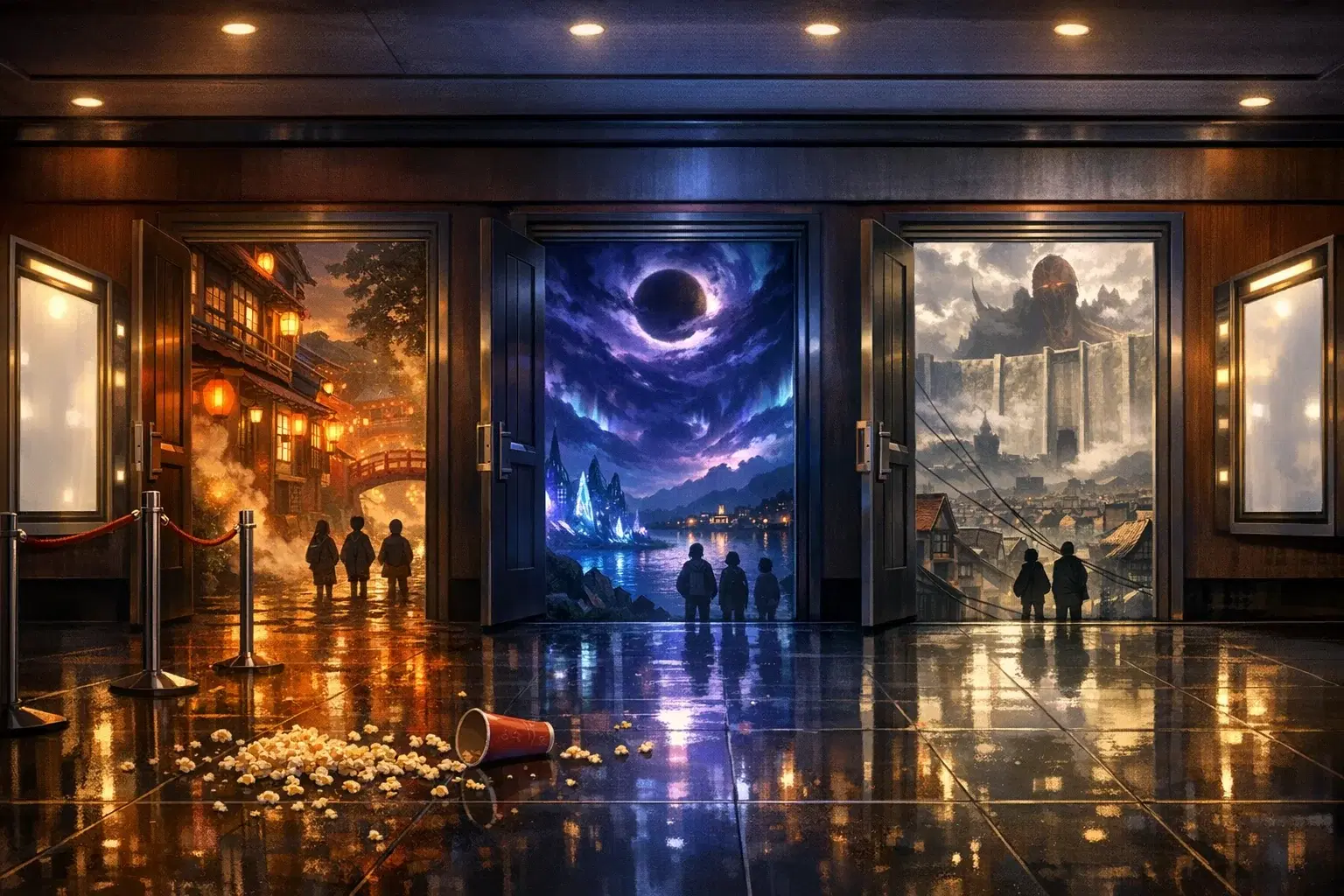
Anime movies didn’t “go mainstream” because Hollywood suddenly discovered Japanese animation in 2025. They went mainstream because theaters and distributors finally learned how to sell anime like what it actually is: an event.
The last few years have quietly rewritten the old Western playbook where anime films were treated as niche imports—one-weekend-only curiosities, dumped into a handful of screens, then rushed to home video or streaming. In 2025–2026, the theatrical strategy flipped. Big titles started getting real rollout muscle, longer windows, and a clear understanding that fandom isn’t just an audience—it’s a mobilization engine.
And here’s the part some people still don’t want to admit: theatrical anime is no longer simply “extra content” for TV series fans. It’s becoming a parallel prestige lane for the medium—one where a film can be the headline product, not the side dish. That shift matters, because it changes what gets funded, how it’s marketed, and how the wider public perceives anime as cinema rather than “cartoons you stream.”
The Evidence
The clearest proof is the way theatrical runs have expanded from “limited engagement” to “sustained presence.” The poster child is the franchise juggernaut Demon Slayer: Kimetsu no Yaiba, whose film era has essentially trained mainstream theaters to treat anime like a must-book genre rather than a novelty. When Demon Slayer: Kimetsu no Yaiba - The Movie: Mugen Train proved that a shonen property could print money globally, it didn’t just validate one series—it validated a distribution model.
That model hit another level with Infinity Castle (as reported across multiple outlets in the brief): a Japan premiere in July 2025, a U.S. rollout in September 2025, and—most tellingly—a long theatrical life that reportedly stretched roughly nine months with re-screenings. Even if you’re skeptical of any single outlet’s exact totals, the broader pattern is hard to dispute: this wasn’t a “blink and you miss it” anime weekend. It was a true theatrical campaign, with the kind of legs that theaters used to reserve for family animation or awards-season breakouts.
Then came the one-two punch that made the trend impossible to dismiss: Chainsaw Man landing a movie release that, per wire reporting and box office coverage in the brief, topped a North American weekend with a roughly $17M domestic haul and crossed into nine-figure territory worldwide. This is the part that should make theater owners sit up straight: anime isn’t only winning when it’s the only thing fans can rally around. It’s winning in competitive frames against live-action studio product.
But the real industry tell isn’t just “big movies did big numbers.” It’s that distributors are now building repeatable theatrical programming around anime.
Crunchyroll’s “Anime Nights” initiative—described in the brief as a monthly theatrical event across roughly 225 U.S. theaters—signals a strategic shift from one-off releases to a calendar. That’s huge. A calendar means predictable bookings, predictable marketing beats, and consistent audience conditioning. It’s the same logic that built modern concert films and faith-based releases: you don’t need every title to be a mega-hit if you can reliably bring a passionate audience into seats.
Even more importantly, this strategy leans into what anime fandom already does best: show up together. If you’ve ever watched the communal hype cycle around Jujutsu Kaisen or the long-running social media discourse machine for Attack on Titan (and its later arcs like Attack on Titan: Final Season), you know the culture thrives on shared moments. Theaters are now packaging that shared moment as a product.
And it’s not just new releases. Legacy anime is being repositioned as theatrical “repertoire,” which is how film culture treats classics. The Ghibli re-release model—built around titles like Spirited Away and The Wind Rises—works because it reframes anime as something you go out to see, not something you stumble onto in a streaming queue. That’s a subtle but powerful upgrade in cultural status.
Finally, the timing matters. One reason anime films are thriving is that the broader theatrical market is still recovering. The brief notes 2025’s North American box office improved but remained below pre-pandemic highs. In that environment, any category that can reliably generate turnout becomes disproportionately valuable. Anime’s advantage is that it’s not just “content”—it’s a fandom-driven appointment.
Otaku Insider’s take: This is the healthiest kind of mainstreaming. It’s not anime sanding itself down to appeal to everyone; it’s theaters adapting to anime’s existing strengths—community, repeat engagement, and high emotional investment. If anything, the mainstream is learning to meet anime where it already lives.
The Counterargument
There’s a fair critique floating around: anime movies aren’t truly “mainstream,” they’re just benefiting from a loud, organized fanbase. In other words, the medium isn’t becoming dominant—fandom is simply better at mobilizing than general audiences. That argument shows up frequently in industry chatter and fan discussions, and it’s not wrong to point out that anime turnout can be front-loaded and community-driven.
But here’s why I think that critique misses the point.
First, in modern theatrical economics, mobilization is mainstream. Superhero openings, horror spikes, concert films—Hollywood has been chasing “fan-driven” for a decade. Anime is succeeding because it’s doing what the theatrical business now requires: delivering a motivated audience willing to leave the house.
Second, the “it’s only fans” argument assumes fans are a closed circle. They’re not. Fandom is a recruitment pipeline. People don’t become fans in a vacuum—they become fans because friends drag them to an event, because clips trend, because the theater experience makes it feel bigger than life. That’s how a title like Your Name. becomes a gateway for newcomers, or how emotionally resonant films like A Silent Voice keep circulating beyond the usual shonen crowd.
Third, the long-window strategy cuts against the idea that anime films are purely opening-weekend explosions. A months-long theatrical presence (as reported for Infinity Castle in the brief) is the opposite of a disposable fan spike. It suggests repeat viewings, word-of-mouth, and exhibitors seeing enough demand to keep booking screens.
So yes—fandom is the engine. But that doesn’t disqualify anime from being mainstream. It’s the same way Pokémon: The Rise Of Darkrai could pack seats in a different era: the brand brought people in. The difference now is that the market infrastructure is finally built to scale that demand.
The Conclusion
The rise of anime movies in mainstream theaters isn’t a quirky 2025 headline—it’s a structural change. Longer theatrical windows, eventized programming, and distributors treating anime as a year-round category have turned what used to be “specialty releases” into reliable box office plays.
The biggest proof isn’t just that Demon Slayer: Kimetsu no Yaiba can dominate globally or that Chainsaw Man can top a weekend. It’s that the industry is building systems—like recurring theatrical events and prestige re-releases—that assume anime belongs on the big screen as a normal part of moviegoing.
Now the question becomes: what kind of anime cinema do we want theaters to reward next? More franchise tentpoles, more auteur-driven originals, more repertory classics? Tell us what you’d actually buy a ticket for—and which series you think is next to make theaters treat anime like a guaranteed draw.
Sources
- [1] Demon Slayer: Infinity Castle's nine-month theatrical run has finally come to an end, and there's still no Crunchyroll streaming date in sight (gamesradar.com)
- [2] 'Chainsaw Man' anime film topples Springsteen biopic and 'Black Phone 2' at the box office (apnews.com)
- [3] Anime Rules The Box Office Again As Chainsaw Man - The Movie: Reze Arc Tears Through The Competition (cinemablend.com)
- [4] La fuerza imparable del 'anime' en 2025 revienta la taquilla a katanazos (elpais.com)
- [5] The 2025 box office comeback that wasn't (axios.com)
- [6] Crunchyroll is launching Anime Nights, a theatrical event designed to give fans "a shared experience that honors the art form" - and here are the first two movies you can watch in cinemas (gamesradar.com)
- [7] 6 of the Best (& 2 Most Underrated) Studio Ghibli Films Return to Theaters in 2025 (cbr.com)
- [8] HIDIVE Brings The Dangers in My Heart: The Movie to U.S. Theaters on February 16 & 18 | AnimeTV (animetv-jp.net)
- [9] The Last Blossom Anime Film Heads to North American Theaters This August - Crunchyroll News (crunchyroll.com)
- [10] Sony Pictures Screens Mamoru Hosoda’s Scarlet Anime Film in U.S. Theaters on December 12 (anitrendz.net)
- [11] How Anime Films Became Massive Box Office Hits in the 2020s (collider.com)
- [12] Anime Succeeds At Box Office: ‘Chainsaw Man’ Latest Hit After ‘Demon Slayer’ (forbes.com)
- [13] Anime’s massive success in US theaters has more to do with the power of fandoms than the medium itself becoming dominant, according to Japanese filmmaker and journalist (reddit.com)
- [14] Will non-family oriented animated films ever become mainstream in the U.S.? (reddit.com)
- [15] United States Anime Genres Market By Genre (Shonen, Shojo, Seinen, Isekai, Mecha, Others), By Audience (Children, Teenagers, Adults), By Distribution Channel (Streaming Services, Broadcast TV, Blu-Ray/DVD, Theatrical Releases), By Format (TV Series, Movies, Web Series), By Region, Competition, Forecast & Opportunities, 2020-2030F (pdf.marketpublishers.com)
- [16] Sunrise Commemorates 50th Anniversary with Six Short Movies (MAL_RSS)
- [17] Atsushi Nishigori and CloverWorks' GROTESQQQUE Anime Film Reveals Lineup of 35 Music Artists (CRUNCHYROLL)
- [18] Fist of the North Star: Hokuto no Ken Anime Reveals Voice actors for Airi, Madara (CRUNCHYROLL)
- [19] Psyren Anime Streams 1st Teaser With Anime Footage (ANN)
- [20] CloverWorks' Omnibus Anime Film Grotesqqque Reveals 35 Musical Contributors (ANN)
- [21] Chainsmoker Cat Anime Casts Rina Honnizumi (ANN)
- [22] Crunchyroll Reveals Summer 2026 Anime Lineup Including Mushoku Tensei Season 3, Black Torch, & 50+ More Titles (ANIME_CORNER)
- [23] Clevatess Anime Shows Off the Daily Life of Season 2 Characters in New Visual (CRUNCHYROLL)
- [24] A Returner's Magic Should Be Special Season 2 Anime Reveals Romantica Eru Character Trailer (CRUNCHYROLL)
- [25] Crunchyroll Summer 2026 Anime Season Lineup Announced! (CRUNCHYROLL)
- [26] Mika Nakashima Shares A Hundred Scenes of AWAJIMA Anime Ending Song Music Video (CRUNCHYROLL)
- [27] Super Psychic Policeman Chojo Anime Reveals Main Cast, Trailer and Visual (CRUNCHYROLL)
- [28] Cyborg 009 Nemesis Anime Unveils July 19 Premiere, Key Visual (CRUNCHYROLL)
- [29] "Just Like Mona Lisa" Confirmed Anime Adaptation, Teaser Visual & Special Illustration with Comment from Author Tsumuji Yoshimura Revealed (ANN)
- [30] Yoshitaka Amano's ZAN Limited Anime Series Debuts 1st Trailer at Anime Expo on July 3 (ANN)
Written by Ranen with AI support — Ranen picks every story, shapes the angle, and reviews each article before it's published. Learn more in our editorial policy.