YuruYuri: Happy Go Lily
ゆるゆり (Yuru Yuri)
- Award Winning
- Comedy
- Girls Love
- CGDCT
- Gag Humor
- School
- Episodes
- 12
- Duration
- 23 min per ep
- Aired
- Jul 5, 2011 to Sep 20, 2011
- Status
- Finished Airing
Synopsis
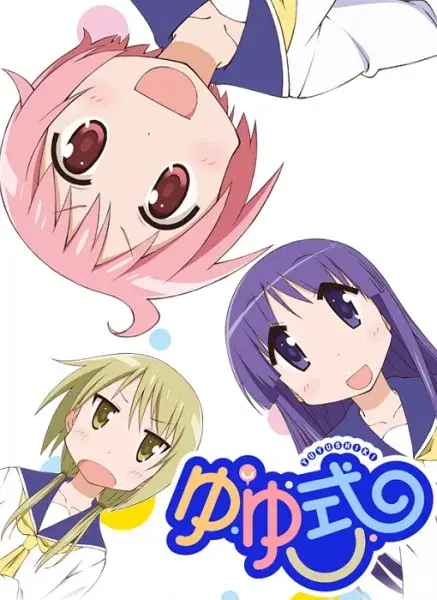
Starting her first year at an all-girls middle school, Akari Akaza reunites with her childhood friends Yui Funami and Kyouko Toshinou after spending the previous year apart. The older girls have already claimed the former Tea Club room for their own “Amusement Club,” a laid-back hangout created simply to pass the time and have fun.
When classmate Chinatsu Yoshikawa drops by expecting to find the Tea Club, she learns it has been disbanded and is soon persuaded to join the Amusement Club instead. Adapted from Namori’s slice-of-life manga, *YuruYuri: Happy Go Lily* follows the girls’ everyday antics—tea, teasing, and affectionate bickering included—often with the running joke that Akari, despite being positioned as the lead, is routinely overlooked.
Otaku Consensus
YuruYuri: Happy Go Lily earns its following through Masahiko Oota’s unfussy comic direction, Takashi Aoshima’s clean episodic pacing, and a Doga Kobo adaptation that understands Namori’s manga as a joke-delivery machine rather than a drama engine. Its best weapon is the way it turns clubroom downtime into meta, slapstick, and affectionate yuri-adjacent chaos, while the most persistent criticism is that the gag hit-rate can feel uneven when a sketch leans on cuteness instead of sharper comic writing.
Why You Should Watch
Watch YuruYuri if you want the clubroom warmth of K-On! without the music-show payoff structure, or the schoolgirl absurdity of Nichijou dialed down into compact, repeatable character gags. It is especially good for viewers who like comedy built from social rhythms: one girl overperforms, another deadpans, a crush distorts the room, and the show keeps puncturing its own “main character” logic. The 12-episode first season is easy to sample because it is episodic, but it is not shapeless; the humor accumulates through recurring roles, meta interruptions, and increasingly specific chemistry. If your tolerance for CGDCT depends on actual joke construction rather than pure softness, this is one of the genre’s more instructive 2011 snapshots.
Key Characters
- AAkari Akaza(VA: Shiori Mikami)
Akari is remembered less as a conventional lead than as a meta-comedy device, with her supposed protagonist status constantly undercut by the show’s own timing.
- YYui Funami(VA: Minami Tsuda)
Yui functions as the dry, stabilizing counterweight whose restrained reactions make the louder personalities around her land harder.
- KKyouko Toshinou(VA: Rumi Ookubo)
Kyouko is the season’s main chaos engine, the kind of overconfident gag character fans latch onto because she can push a normal scene into slapstick or surreal territory instantly.
- CChinatsu Yoshikawa
Chinatsu sharpens the group dynamic by bringing overtly romantic tension into otherwise casual clubroom comedy, especially through the show’s yuri-tagged character friction.
What Makes It Stand Out
- 1
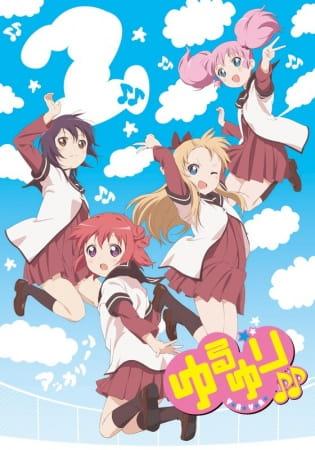
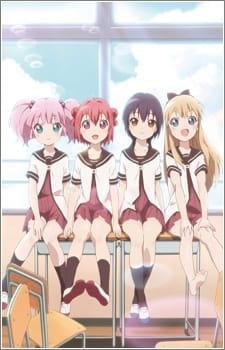
Doga Kobo’s first-season visual approach is bright and toy-like rather than heavily detailed; one contemporary Blu-ray review compared its cutesy color sense to old Nintendo and Hello Kitty aesthetics while noting that it largely avoids chibi shorthand.
- 2
The series is structurally gag-first: AniList’s high tags for Meta, Surreal Comedy, Episodic, and Slapstick reflect how often scenes are built around format jokes, abrupt escalation, and repeatable character roles instead of plot progression.
- 3
Masahiko Oota directs with Takashi Aoshima on series composition, a pairing that keeps the 12-episode season brisk and sketch-like rather than trying to force a larger dramatic arc onto Namori’s slice-of-life source material.
- 4
The yuri element is presented as comic energy more than melodrama, which is why the show can sit simultaneously under Girls Love, CGDCT, Love Triangle, and School Club tags without feeling like a conventional romance series.
- 5
Yasunori Ebina’s sound direction and Yasuhiro Misawa’s music support the show’s light gag rhythm, while the opening and ending performances by Shiori Mikami, Minami Tsuda, and Rumi Ookubo reinforce its cast-driven identity.
Fun Facts & Trivia
- Fun fact 1
- The anime adapts Namori’s manga and aired as a 12-episode TV season from July 5 to September 20, 2011, placing it in the early-2010s boom of school-club CGDCT comedies.
- Fun fact 2
- Its English subtitle, Happy Go Lily, is a punny localization that matches the title’s soft yuri branding without making the series sound like a straight romantic drama.
- Fun fact 3
- The production credits include Masahiko Oota as director, Takaharu Ookuma as assistant director, Takashi Aoshima on series composition, and Chiaki Nakajima on character design.
- Fun fact 4
- Shiori Mikami, Minami Tsuda, and Rumi Ookubo are credited on both the opening and ending theme performances, tying the show’s musical packaging directly to its main-character appeal.
- Fun fact 5
- Its database footprint is unusually strong for a lightweight gag comedy: MAL lists it at 7.56 from 158,477 votes with popularity rank #781, while AniList records a 74/100 score and 1,961 favourites.
Studios
- Doga Kobo